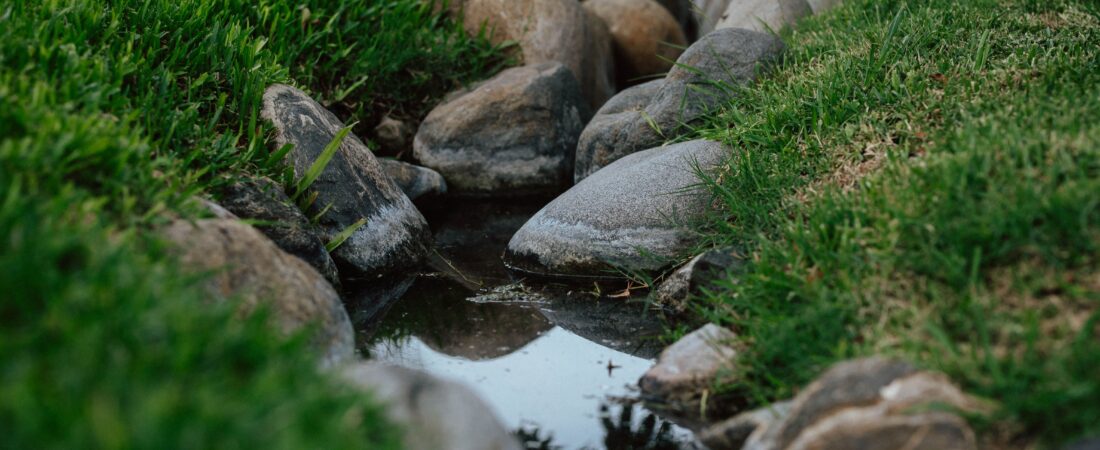
A puddle that sits on the lawn for three days, a muddy trench carved beside the path, water pooling against the house: these are all signs that rainwater has nowhere good to go. Backyard drainage problems rarely fix themselves, and left alone they can drown plants, kill patches of lawn and, in the worst cases, find their way into a basement.
The good news is that most drainage problems have simple, affordable solutions, and many of them can make the garden look better at the same time.
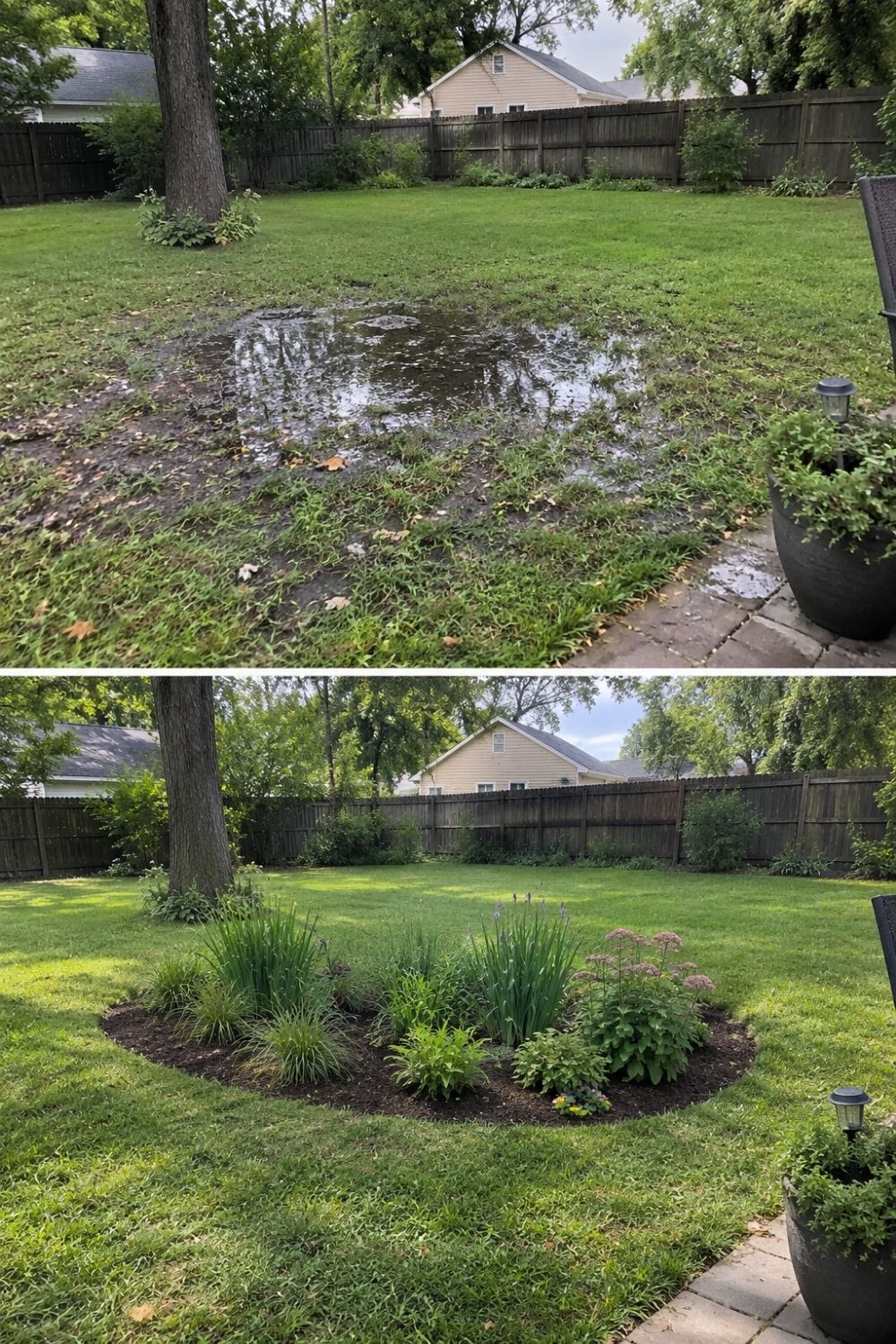
Photo by SassyGarden
The before and after above shows what I mean. In the first photo, a wide puddle sits in the middle of a backyard lawn after rain, with muddy, flattened grass around it. In the second, the same low spot has become a round planted bed of grasses, irises and flowering perennials. The water still collects there, but now it soaks into a garden instead of a soggy patch of lawn. That’s the mindset for most yard drainage: instead of fighting the water, give it somewhere useful to go.
First, figure out where the water comes from
Before you tackle any drainage problems, go outside during or right after a heavy rain and watch where the water flows. Most drainage problems come from one of a handful of sources, and each has a different fix:
| What you see | Likely cause | Where to start |
|---|---|---|
| Water pooling at the base of a downspout | Roof water dumped at the foundation | Downspout extension (Fix 1) |
| Damp basement or wet soil against the house | Ground sloping toward the house | Regrading (Fix 2), then a French drain |
| A channel of mud or washed-out mulch | Runoff crossing the yard on a slope | Dry creek bed (Fix 3) |
| A puddle that lasts days in a low spot | Low area with heavy or compacted soil | Rain garden (Fix 4) or French drain (Fix 5) |
| Moss and thin grass across the whole lawn | Compacted clay soil and shade | Aerating and compost, then plants for wet soil |
| Water running off a large patio or driveway | Too many hard surfaces | Permeable surfaces (Fix 7) |
Then do a simple drainage test in the problem spot. Dig a hole about 12 inches deep, fill it with water, let it drain, then fill it again and time how long the second fill takes to disappear. If it drains within a day, the soil can handle a rain garden or planting. If water is still standing after 24 hours, you have heavy clay or a high water table, and you’ll need to move the water somewhere else with a drain.
The drainage fixes below go roughly from the cheapest and easiest to the biggest projects. Start at the top; often the first one or two solve the problem completely.
Fix 1: Move downspout water away from the house
Many yard drainage problems start at the roof. A single downspout can release hundreds of gallons of water during one storm, and if it empties right at the foundation, all of it soaks in beside your walls.
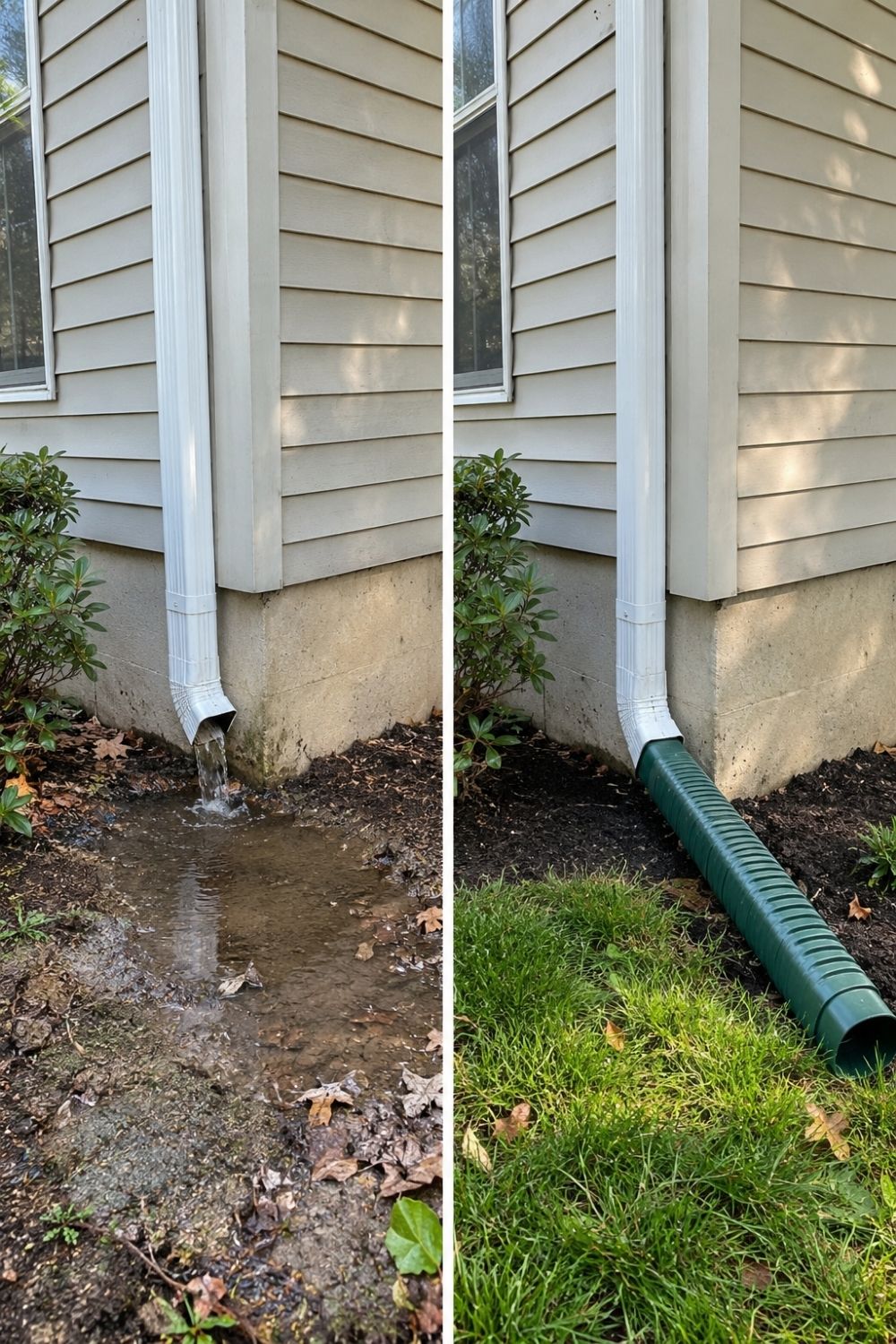
Photo by SassyGarden
The before and after above shows how simple the fix can be. In the first photo, a white downspout empties straight onto bare soil beside the siding, leaving a muddy puddle and washed-away mulch. In the second, a green flexible extension carries the water out across the lawn, and grass has grown back where the puddle used to be.
Aim to release downspout water at least 4–10 feet from the house, on ground that slopes away. Flexible or hinged extensions cost very little, and a splash block at the end stops the water from carving a hole. For a neater look, run the downspout into a buried solid pipe that surfaces as a pop-up emitter in the lawn or empties into a dry creek bed or rain garden. Clean the gutters every fall too; overflowing gutters cause a surprising number of drainage problems.
Fix 2: Regrade the soil away from the house
Over time, soil settles next to foundations, and a slope that once carried water away can end up tilting toward the house. The general guideline is for the ground to fall about 6 inches over the first 10 feet away from the walls.
To check, run a string from a stake at the wall to a stake 10 feet out, level it with a line level, and measure the drop. If it slopes the wrong way, add topsoil against the house and rake it outward to create the fall. Use a soil with some clay in it, not pure sand or mulch, so water runs over it instead of straight through. Regrading solves more drainage problems near the house than almost any other fix. Keep at least 6 inches between the finished soil level and any siding, and don’t bury window wells or vents.
Fix 3: A dry creek bed for runoff
If runoff already carves a path across your yard, you can turn that drainage problem into a feature. A dry creek bed is a shallow channel lined with stones that carries water during storms and looks like a natural stream bed the rest of the time.
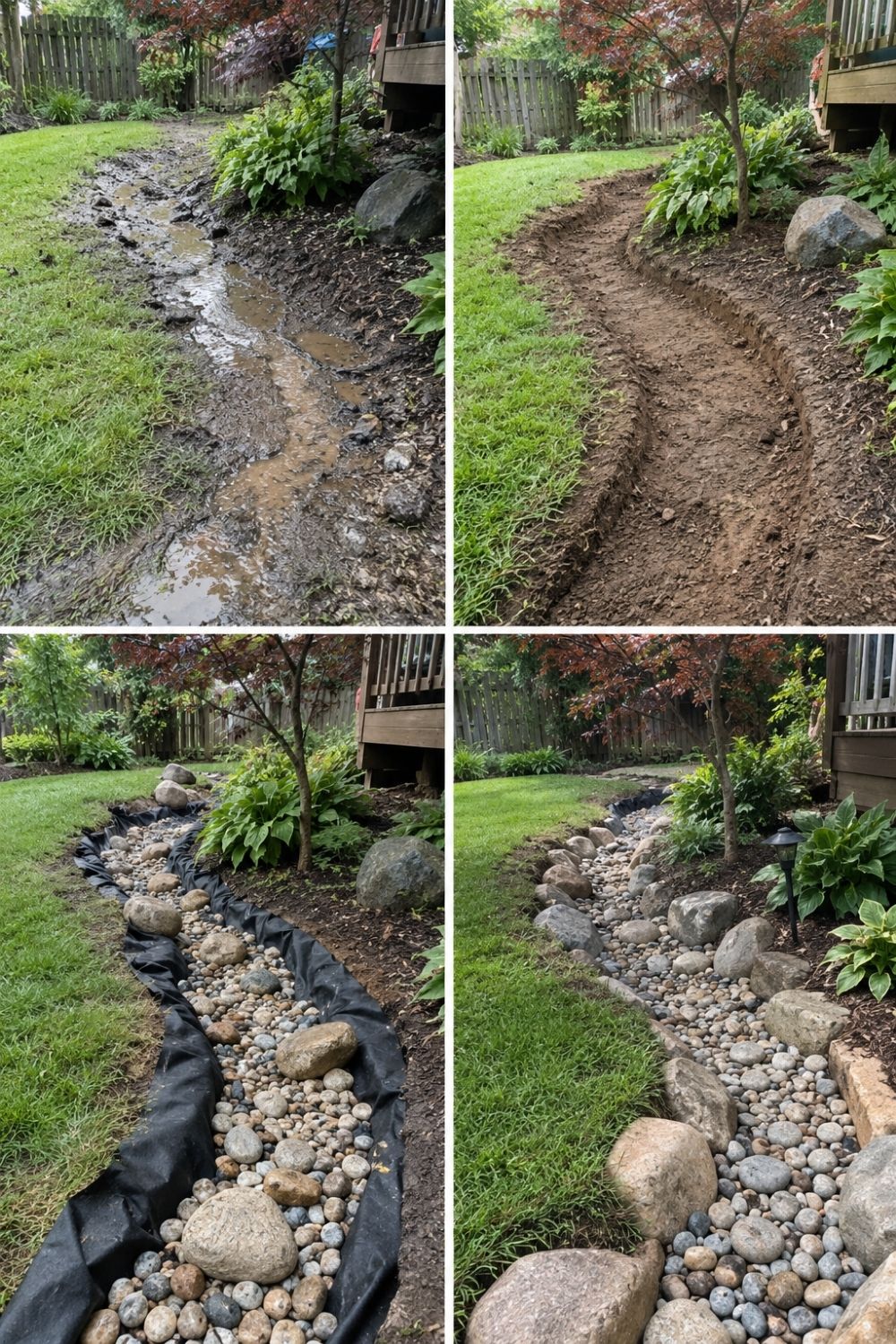
Photo by SassyGarden
The four stages above follow exactly that process. First, a muddy channel runs along the edge of a lawn after rain. Then the channel is dug out into a smooth, curving trench, lined with black landscape fabric and filled with river rock. Finally, larger boulders and plants like hostas and ferns are added along the edges, and the washout has become one of the prettiest parts of the garden.
Dig the channel 8–12 inches deep and about twice as wide as it is deep, with gently sloping sides. Follow the natural flow, and make it curve rather than run in a straight line, since curves look more natural and slow the water down. Use a mix of stone sizes: small pebbles in the bottom, fist-sized rocks along the sides and a few big boulders to anchor the bends. Make sure the lower end empties somewhere safe, such as a rain garden, a lower part of the yard or a street gutter where local rules allow. My post on river rock landscaping has more ideas for choosing and placing the stones.
Fix 4: A rain garden for a soggy low spot
A rain garden is a shallow, planted basin that catches runoff and lets it soak slowly into the ground. It’s the best drainage solution for a low spot where water gathers but the soil drains reasonably well, like the puddle in the first photo of this post.
Place it at least 10 feet from the house and away from septic systems. Dig it 4–8 inches deep, with a level bottom and gently sloping sides, and use the soil you remove to build a low berm on the downhill side. Mix compost into the bottom to loosen it. Water should drain away within a day or two, so it never becomes a breeding pond for mosquitoes.
Plant the center with species that tolerate both flooding and dry spells, and put the plants that prefer drier soil around the edges. Native plants work especially well here, since many are adapted to wet meadows. I covered a rain garden in more detail, with a step-by-step example, in my post on pollinator gardens with native plants.
Fix 5: French drains
When water collects in a spot where it simply can’t soak in, or when it needs to be carried away from a wall, a French drain is the classic solution. It’s a gravel-filled trench with a perforated pipe that collects groundwater and surface water and moves it downhill to a safe outlet.
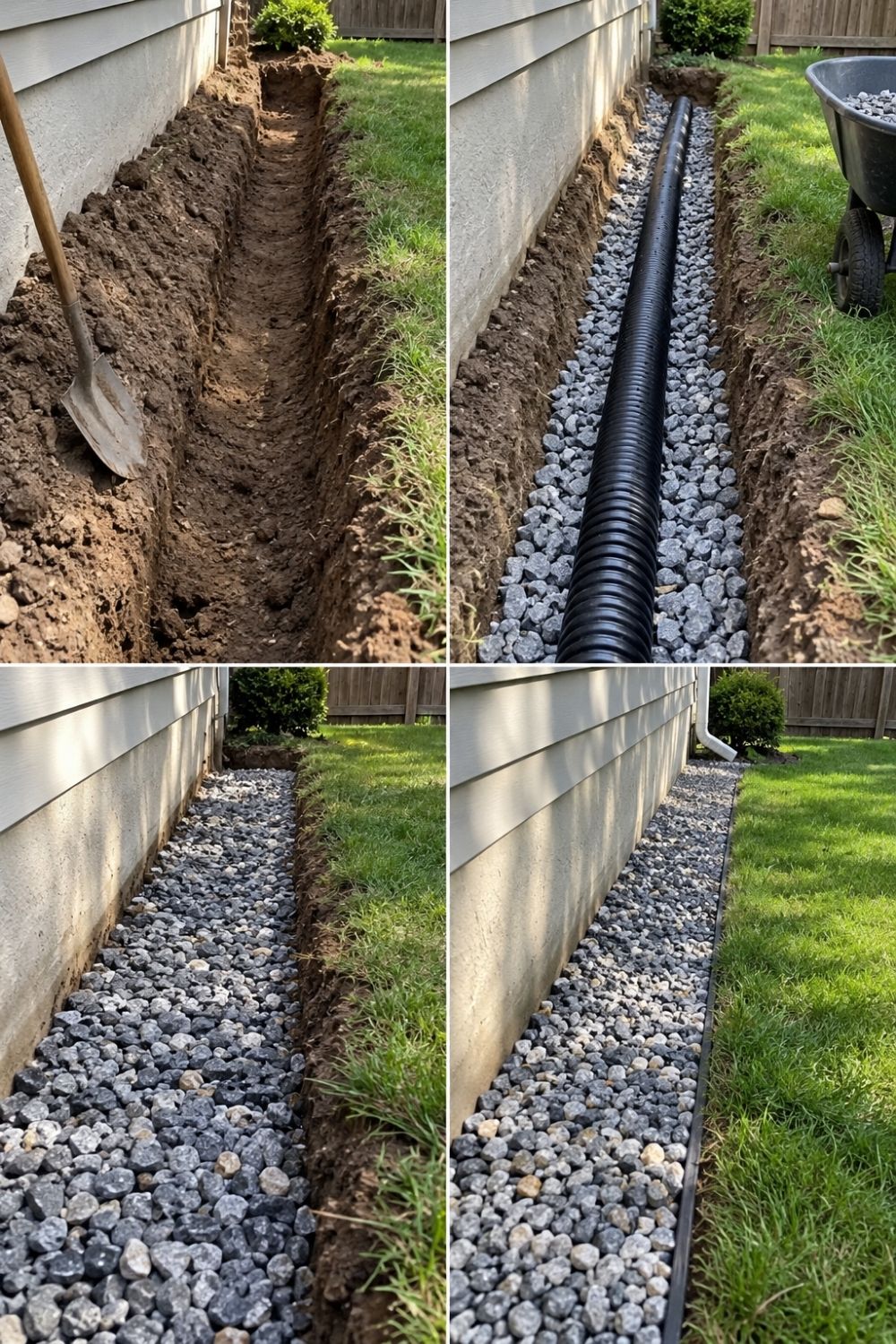
Photo by SassyGarden
The four stages above show the basic build along the side of a house: a narrow trench dug beside the wall, a black perforated pipe laid on a bed of gravel, the trench backfilled with more gravel, and finally the finished drain sitting neatly between the house and the lawn.
The main numbers for a French drain:
- Dig a trench about 6 inches wide and 18–24 inches deep.
- Slope it downhill by at least 1%, roughly 1 inch for every 8 feet, toward the outlet.
- Line the trench with water-permeable landscape fabric to keep soil from clogging the gravel.
- Add 2–3 inches of washed gravel, then lay 4-inch perforated pipe on top, holes facing down.
- Cover the pipe with gravel almost to the top, fold the fabric over and finish with more gravel, sod or river rock.
- Send the outlet somewhere safe, such as a dry well, a rain garden, a dry creek bed or the lowest part of the yard.
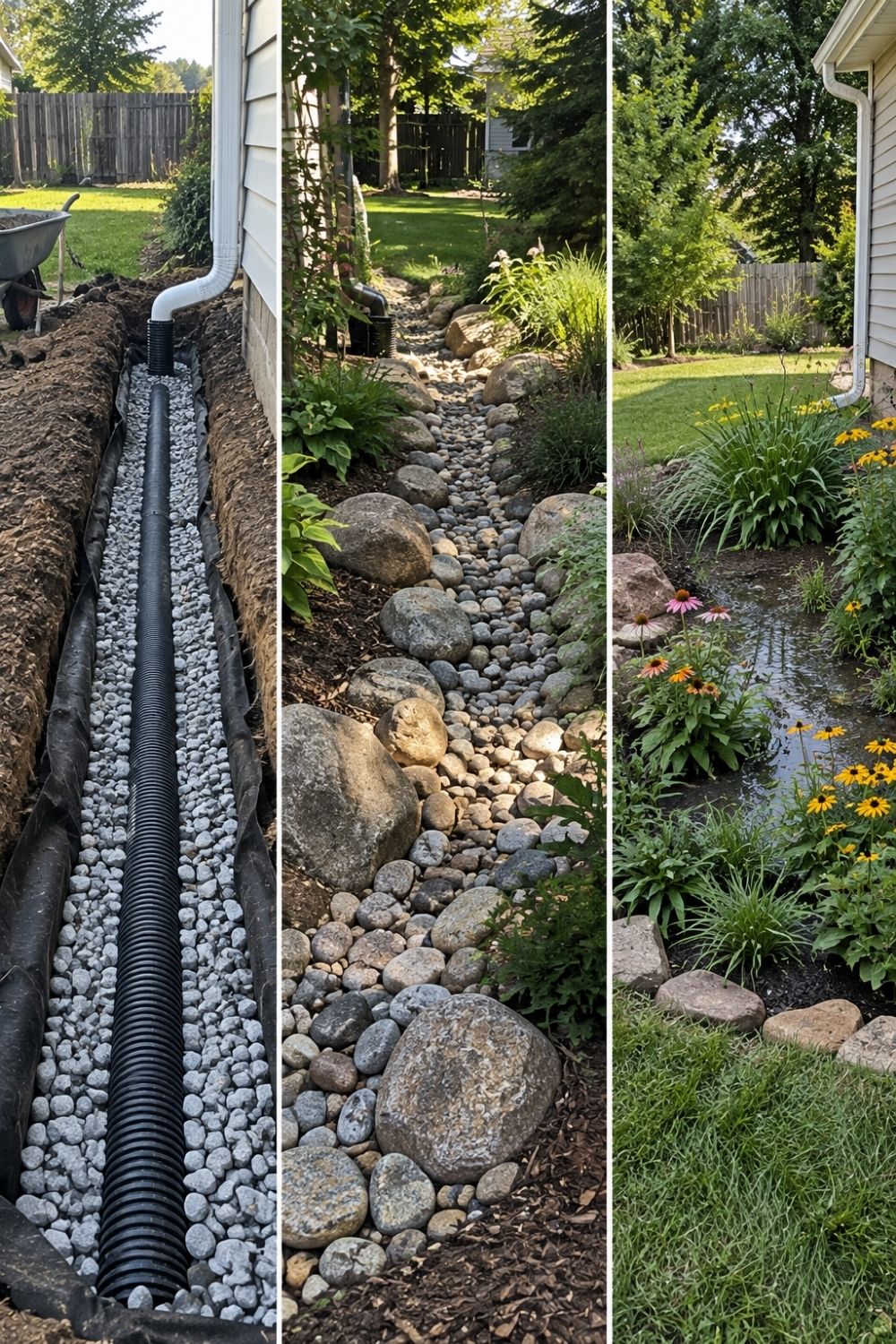
Photo by SassyGarden
The three photos above show the full system: a downspout feeding a perforated pipe in a gravel-filled trench, the pipe emptying into a stone-lined dry creek, and the creek finally leading water into a planted rain garden with rudbeckias and grasses. Connecting the fixes like this means the water is handled from the roof to the soil, without ever pooling.
Before digging anything deeper than a few inches, call 811 in the US, or your local utility locating service elsewhere, to mark buried lines. For a detailed walk-through with photos, Lawn Love’s guide to installing a French drain covers each step.
Fix 6: Protect the foundation
Water against a foundation is the most serious drainage problem in any yard, because it can lead to damp basements, cracks and mold. Regrading and downspout extensions solve most cases, but for persistent problems a drain right along the wall may be needed.
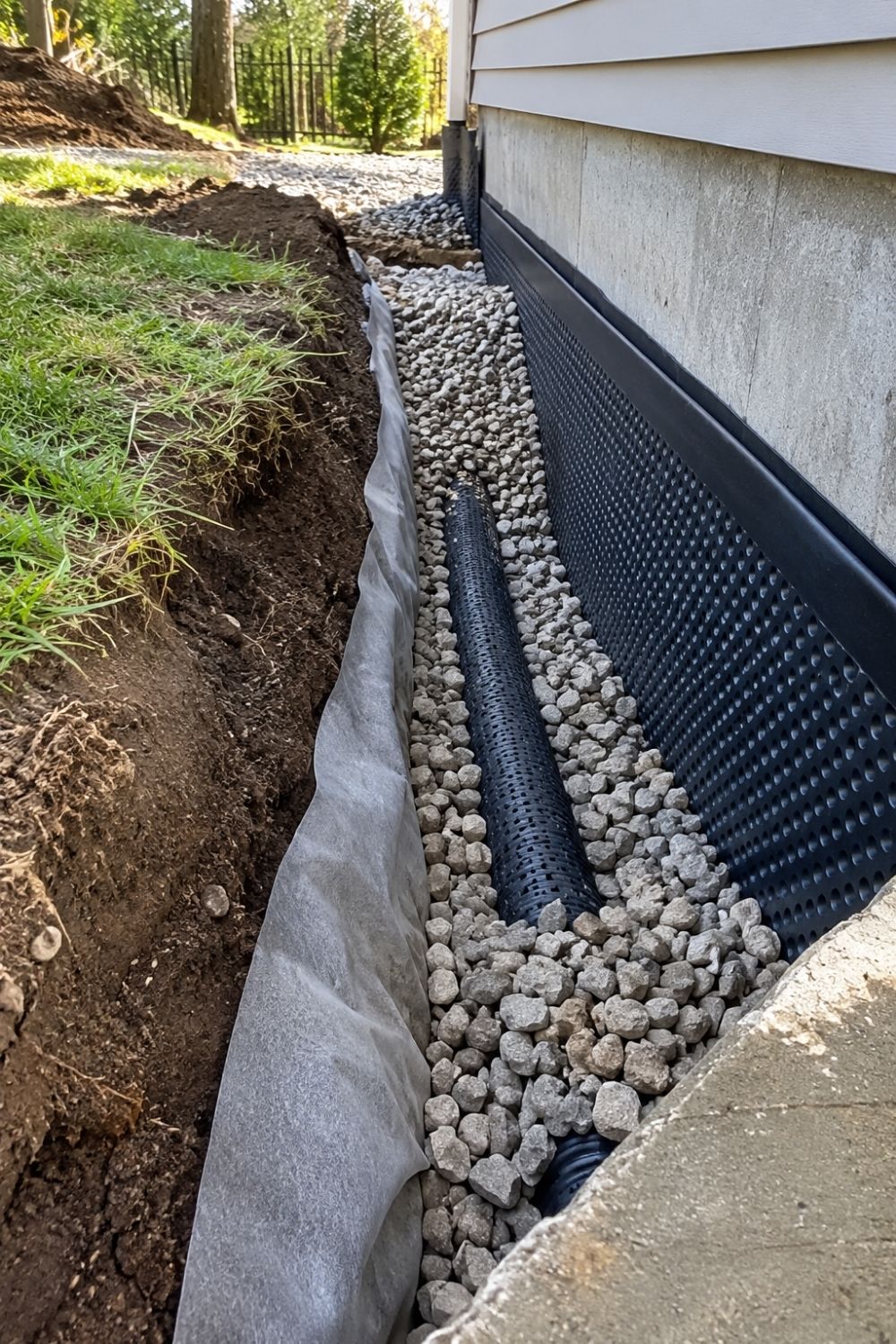
Photo by SassyGarden
In this photo, the soil along a house wall has been dug out to reveal a dimpled black waterproofing membrane against the foundation, with a perforated drain pipe laid in gravel and wrapped in fabric at its base. This kind of exterior foundation drain carries water away before it can press against the wall.
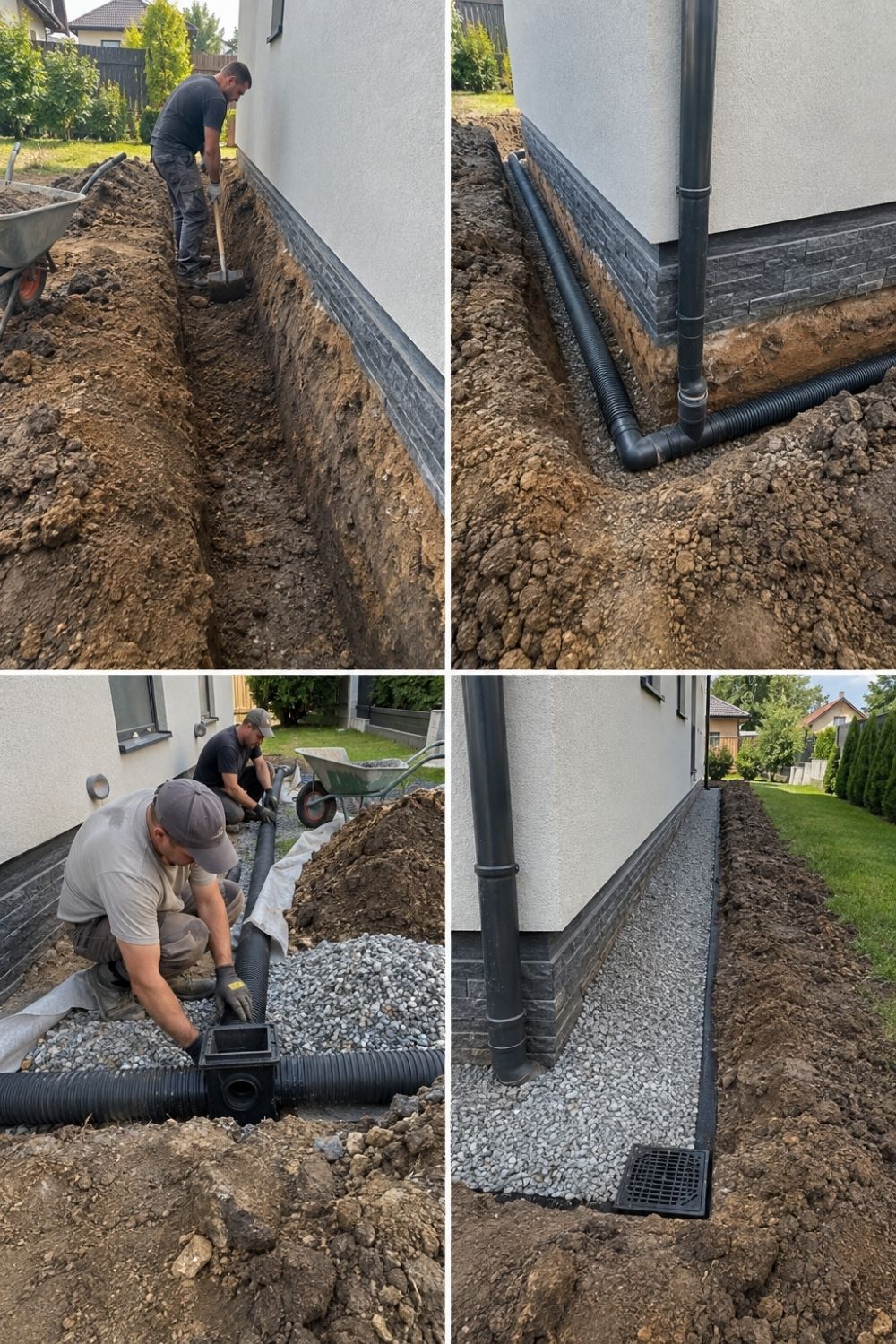
Photo by SassyGarden
The four photos above show a related project: a trench dug along the base of a house, a downspout connected underground, a catch basin and pipe set in gravel, and finally a neat gravel strip with a grate running along the wall. A gravel strip 12–18 inches wide along the foundation also keeps soil from splashing onto the siding and makes a clean, low-maintenance edge. Foundation drains are big projects, though, and digging next to walls can undermine footings, so this is a job to discuss with a professional if you have water inside the house.
Fix 7: Swap hard surfaces for permeable ones
Patios, driveways and paths shed every drop of rain that falls on them, often straight onto the lawn or toward the house. Replacing some hard surfaces with materials that let water through reduces runoff and eases yard drainage at the source.
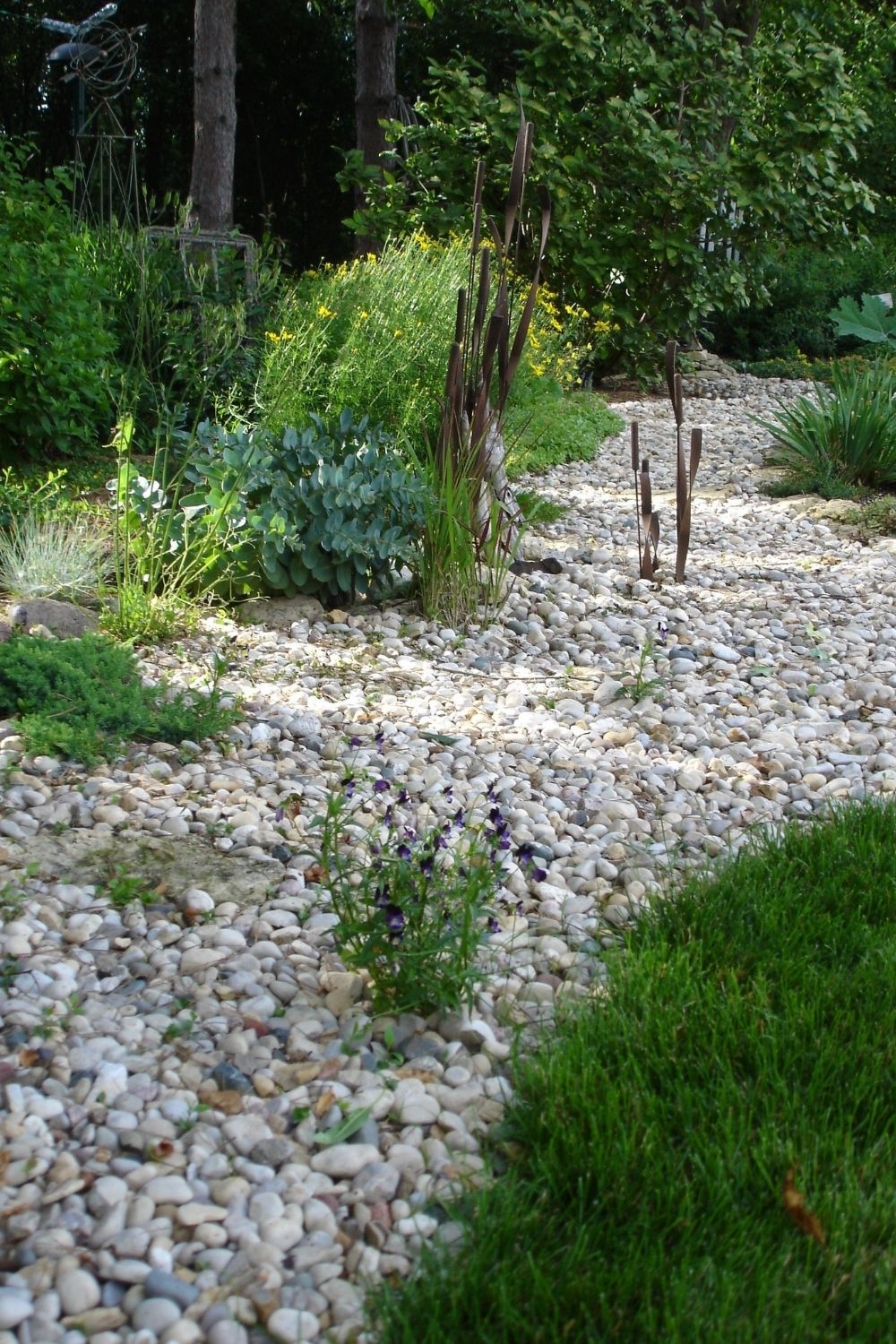
Image by Brooke Rogers from Pixabay
This gravel garden, with a wide area of pale pebbles edged by lawn and planted with sedums, grasses and small perennials, shows how attractive a permeable surface can be. Rain soaks straight through the gravel into the soil below. Other good options include permeable pavers with gravel-filled joints, stepping stones set in gravel or groundcover. My post on what makes a garden path look really good covers several permeable path materials.
Plants that like wet feet
In spots with poor drainage that stay damp, choose plants that actually enjoy moisture rather than struggling with it. These cope with wet soil and occasional flooding:
- Swamp milkweed (zones 3–9), a monarch host plant with pink summer flowers.
- Blue flag iris (zones 3–9) and Siberian iris (zones 3–8).
- Cardinal flower (zones 3–9), with bright red spikes that attract hummingbirds.
- Joe-Pye weed (zones 4–9), tall and loved by butterflies.
- Sedges (Carex, many zones), tidy, grassy clumps for edges.
- Red twig dogwood (zones 3–8) and buttonbush (zones 5–9) for shrubs.
- River birch (zones 4–9), one of the few trees that thrives in soggy soil.
Avoid lavender, rosemary and most drought-tolerant plants in these spots; they rot quickly in wet soil. If your yard is mostly heavy clay, raised garden beds are another way to grow vegetables and herbs above the wet ground, and you can save your drought-tolerant plants for the higher, drier parts of the yard.
When to call a professional
Many yard drainage fixes are DIY-friendly, but some problems need an expert:
- Water is coming into the basement or you see cracks in the foundation.
- Runoff from a neighbor’s property is causing the problem, since there may be legal and permit issues.
- The yard is steep or needs a retaining wall taller than about 3 feet.
- The drain would need to reach a street or storm sewer, which often needs a permit.
- You’ve tried the simple fixes and water still stands for days.
Rule of thumb: always start with the simplest drainage fix that deals with where the water comes from, usually the gutters and downspouts, then work outward. Give the water a planned route away from the house, slow it down with stones and plants, and let it soak in where it can do some good.