
The best summer evenings in the garden start just after sunset, when the air cools down and nobody wants to go inside yet. Good lighting is what lets you stay out there. Solar lights make it easy: no wiring, no electrician, no extra bill, and you can move them around until they look right. After a few summers of experimenting, I’ve learned that a handful of well-placed solar garden lights does far more than a whole box of cheap stakes lined up along the lawn.
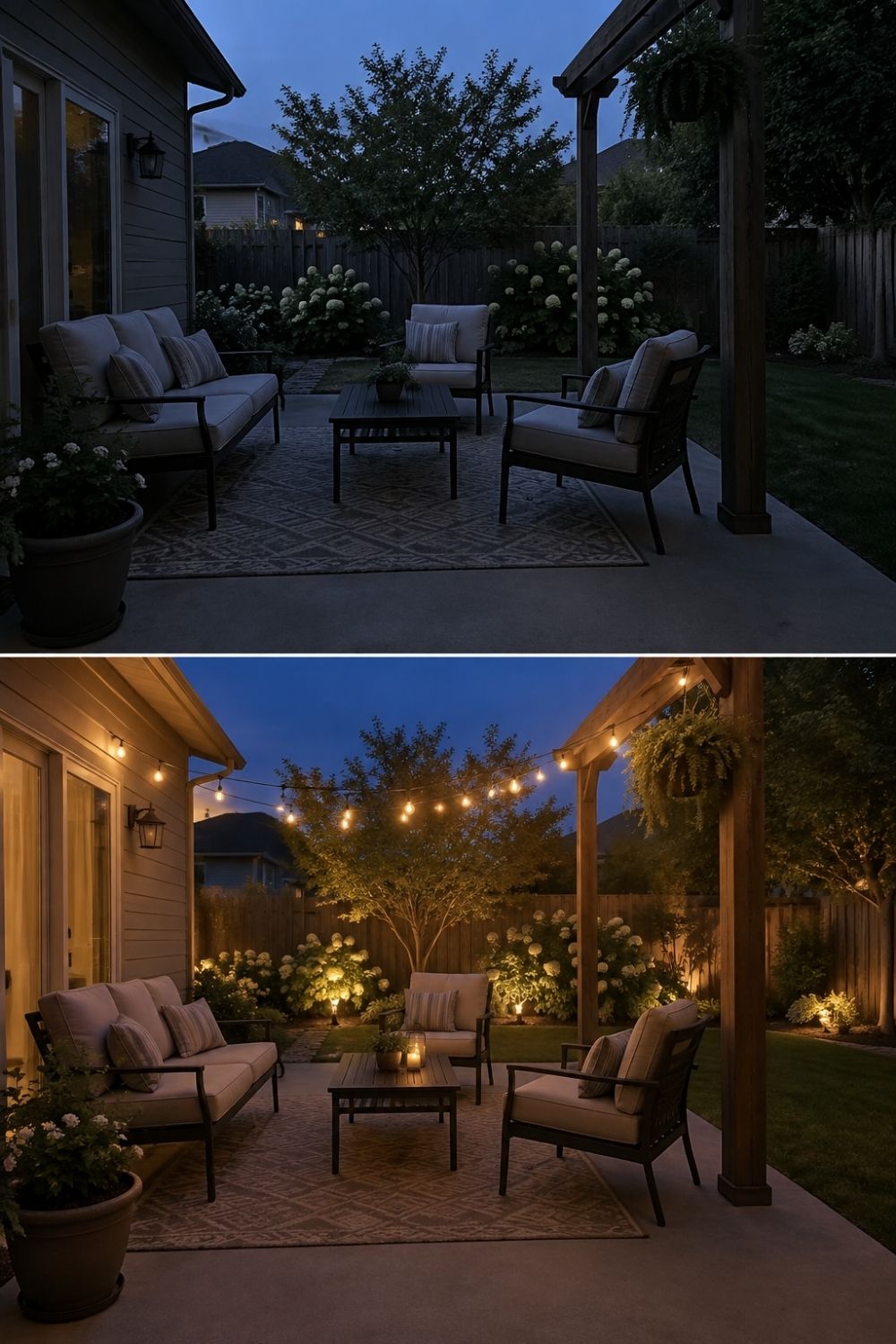
Photo by SassyGarden
The before and after above shows the same patio at dusk. First, the outdoor sofa and chairs sit in near darkness, with only a dim porch light by the door. Then, a zigzag of warm string lights runs overhead, small spotlights glow up into the shrubs and tree behind the seating, and the patio suddenly feels like a room you’d want to spend the evening in. None of it needed a single wire.
Light the path first
If you only add one kind of solar lighting, make it path lights. They’re practical, they guide guests safely, and they give the garden structure after dark.
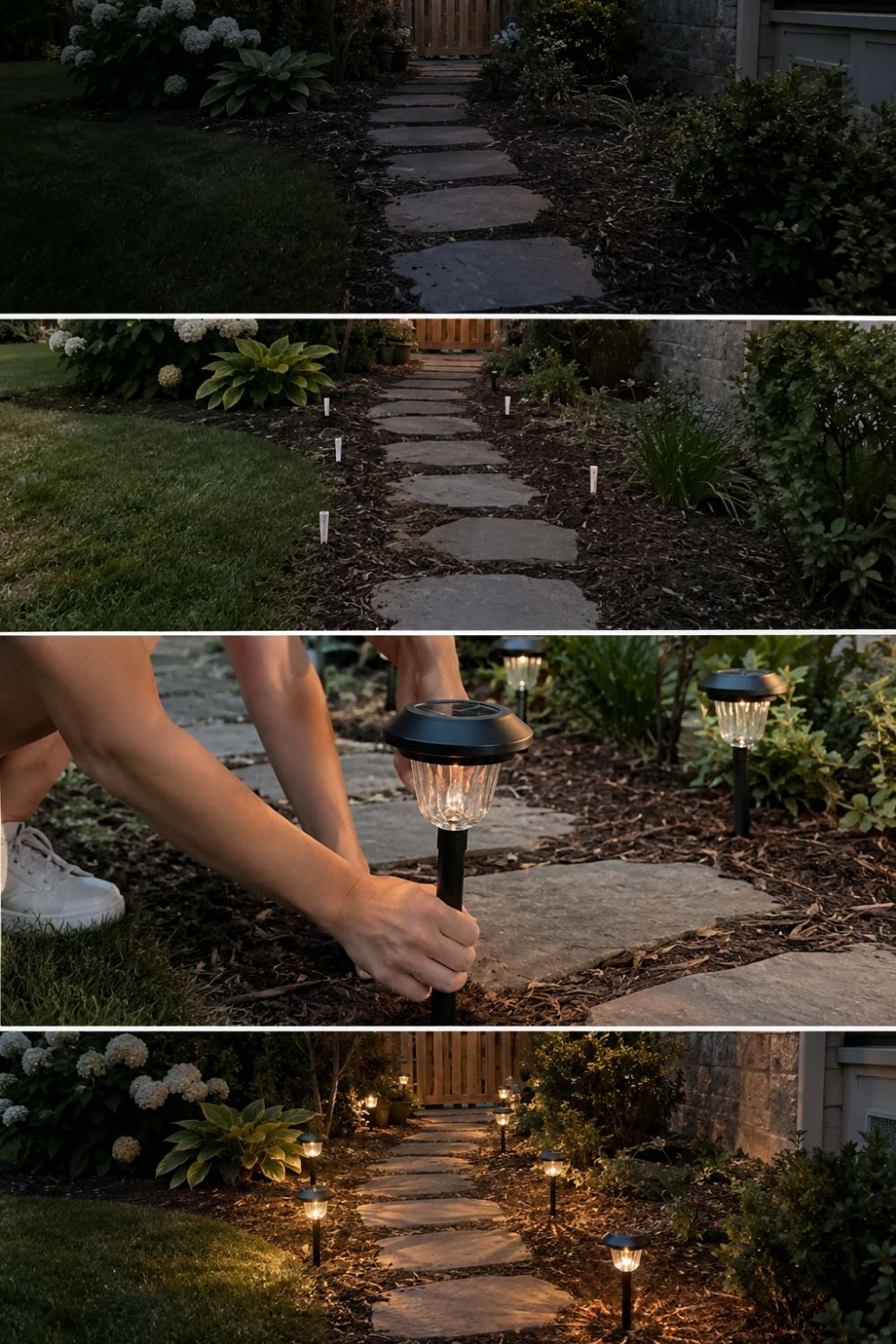
Photo by SassyGarden
The four stages above follow a stepping-stone path through a planted border: first in daylight with no lights, then with small markers where each light will go, then a light being pressed into the soil beside a stone, and finally the finished path glowing with warm pools of light at night. The markers step is worth doing. Laying out a few sticks or stones before you push the stakes in lets you check the spacing from the house.
Stagger path lights on alternating sides rather than lining them up in pairs, which looks like an airport runway. Space them about 5–8 feet apart, depending on how bright they are, and set them a few inches back from the edge so the light falls across the path instead of into your eyes. When I first lit my own path, I used twice as many lights as I needed and packed them close together; taking out every other one made it look better and far less busy. For more on laying out a path itself, see my post on what makes a garden path look really good.
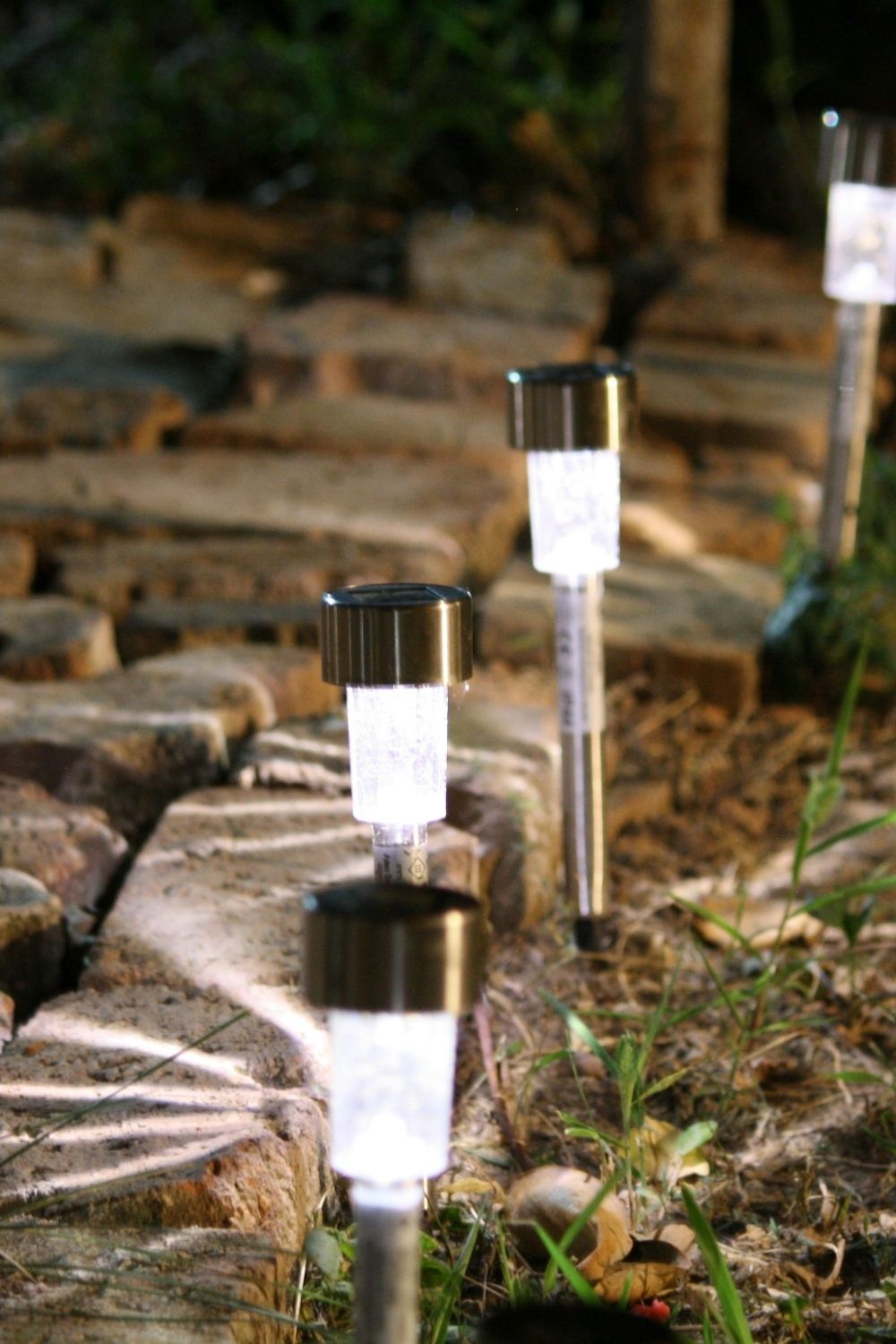
Photo by Fotografia Lui Vlad on Unsplash
Slim stainless-steel stake lights like these, lining a path of rough stone slabs, throw patterned light onto the stones around them. They’re inexpensive and cheerful, but most of them are quite dim and cool-toned. They work best as markers along a path’s edge rather than as your main light source.
String lights over the patio
Nothing makes an outdoor seating area feel like a summer evening faster than a string of warm bulbs overhead.
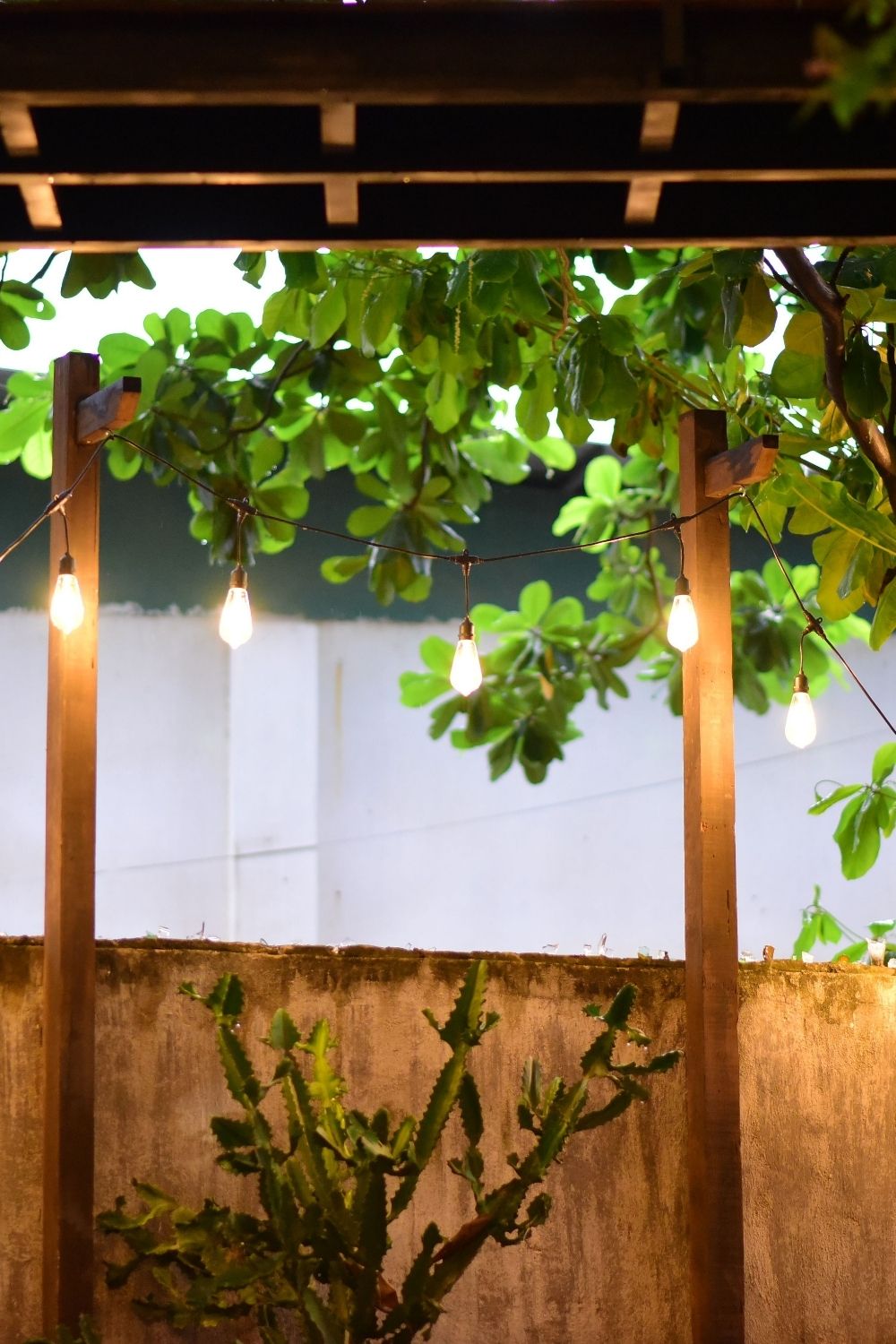
Photo by Sóc Năng Động on Pexels
In this photo, a line of warm string lights hangs between wooden posts under a leafy vine, with a pale wall behind. Solar string lights usually have one small panel on a stake or clip, connected by a long cable, so place the panel where it gets full sun, even if the lights themselves hang in shade under a pergola or tree. Zigzag the strings across the space or drape them in gentle swags between posts, and keep them high enough that nobody walks into them, around 8 feet above the ground. For ideas on building a frame or pergola to hang them from, see my post on garden privacy screens.
Lanterns among the pots
Solar lanterns are the easiest way to add a soft glow to a patio or a group of containers. They sit on a table, hang from a hook or perch on a stake among the plants.
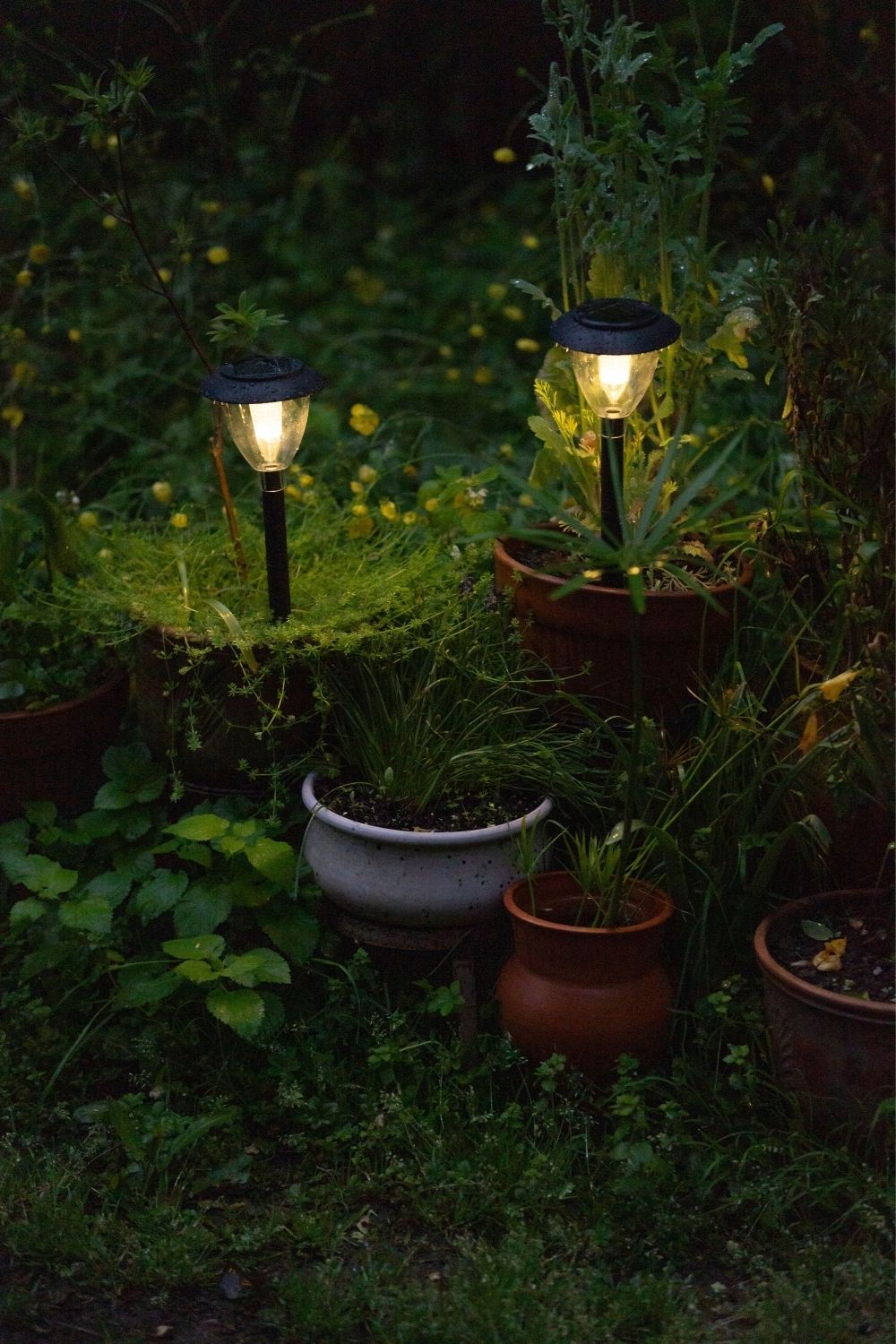
Two black lantern-style solar lights on stakes glow among terracotta and ceramic pots of leafy plants in this garden at night, lighting just the pots around them. Using lights in pairs or threes at different heights looks more natural than one bright lamp. If you’re arranging a group of pots to light, my guide to container gardens covers how to combine heights and shapes.
Spotlight a tree, a wall or a clump of grasses
This is where solar lighting starts to look designed rather than decorative. A small solar spotlight pointed at a single feature creates depth and drama with very little effort.
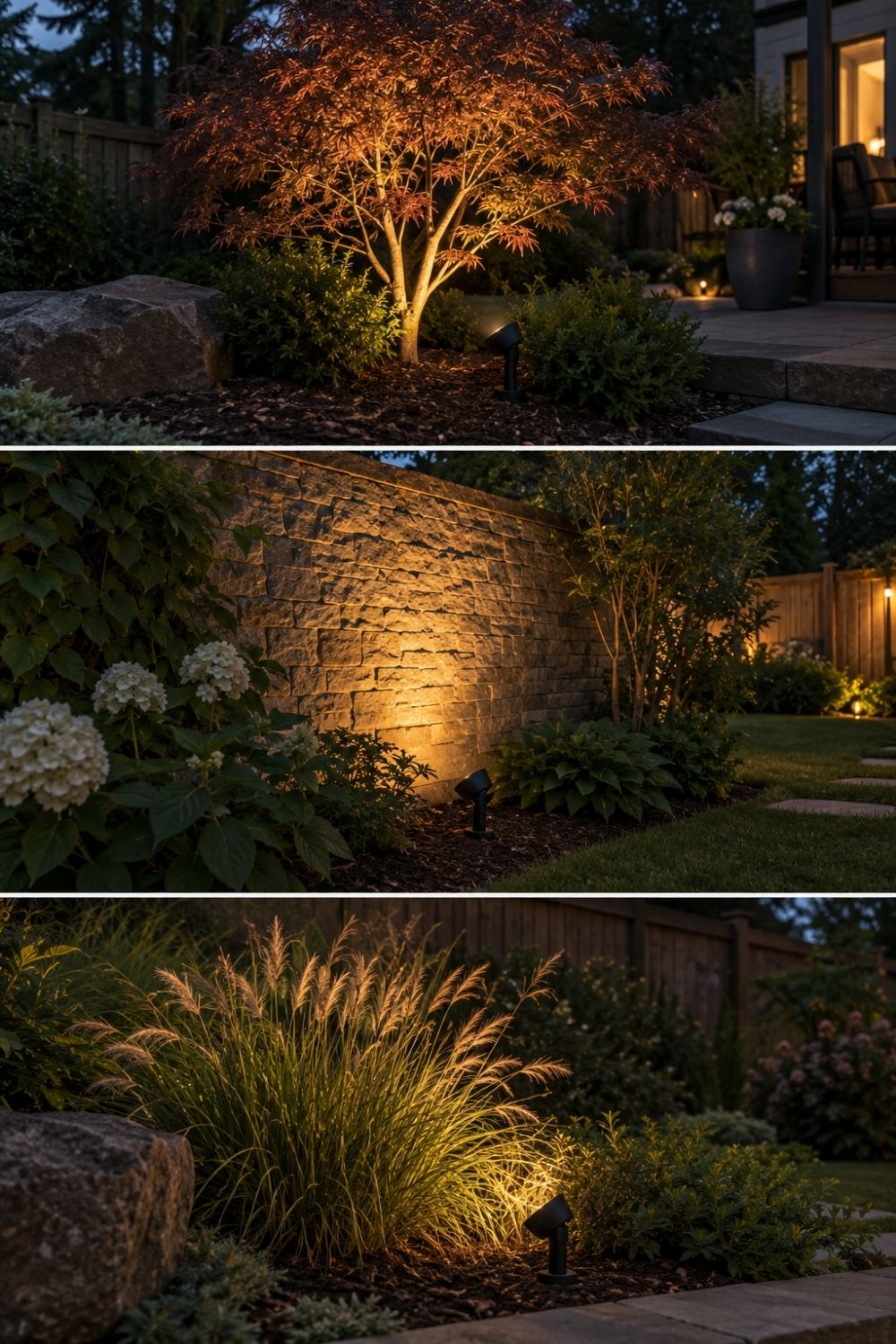
Photo by SassyGarden
The three photos above show three classic techniques. At the top, a Japanese maple is uplit from its base, so the whole canopy glows orange against the dark garden. In the middle, a light set close to a stone wall grazes up its surface and shows off the texture of every stone. At the bottom, a clump of ornamental grasses is lit from the front, and its fine leaves shimmer in the light. Each uses just one light. For uplighting a tree, set the spotlight a foot or two from the trunk and angle it up into the branches. For grazing a wall, put the light within a few inches of it and point it straight up.
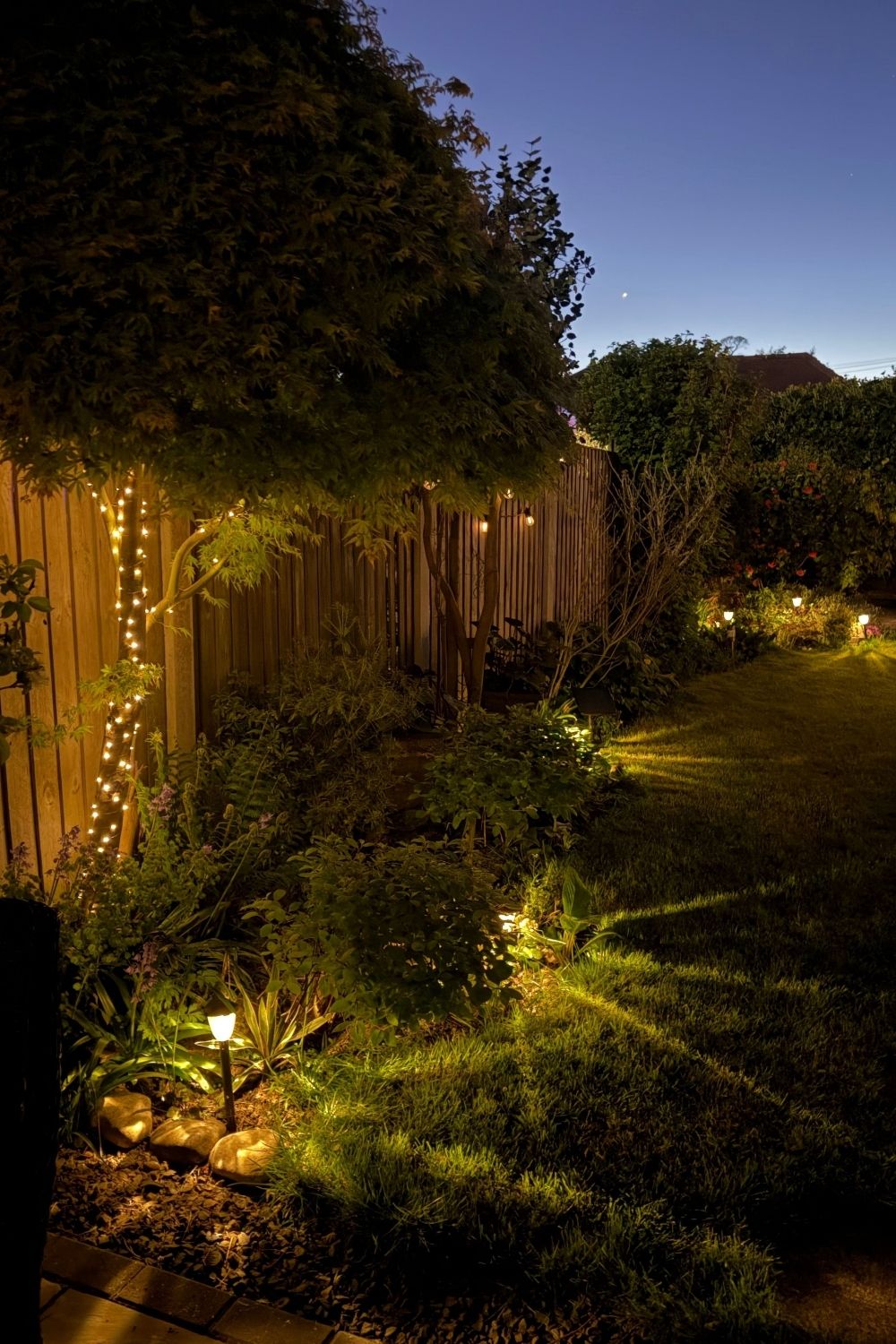
Photo by David Pickup | Advertising & Marketing on Pexels
This backyard at night combines several of these ideas: fairy lights wrapped around a tree trunk by the fence, low lights among the shrubs and a warm glow along the edge of the lawn. Layering a few different types of light, rather than relying on one kind, is what makes it feel so welcoming. The same approach works for a statue or sculpture; I covered placement in my post on garden statues and sculptures.
Motion lights for steps, gates and side paths
Not every light needs to be on all night. Solar motion-sensor lights switch on only when someone walks past, which saves battery and makes them far brighter when they do come on. They’re ideal for steps, side gates, garage corners and the route to the trash cans. Mount them at about 6–8 feet, aimed down at the area you want to light, and put the panel where it gets sun. I keep one by the side gate, and it’s the light I’d miss most if it stopped working.
Where not to put them
A few spots rarely work. Deep shade under evergreens or on the north side of the house won’t charge a panel properly, so use lights with a separate panel you can place in the sun, or skip lighting there. Avoid pointing spotlights toward a neighbor’s windows or your own bedroom, and angle them down or across rather than up into the sky. And resist the urge to light everything: a garden with some dark corners feels deeper and more atmospheric than one lit evenly from end to end.
How bright and how warm?
Solar garden lights vary enormously in brightness, and the packaging rarely makes it obvious. Two numbers help: lumens (brightness) and kelvin (color temperature).
| Use | Brightness | Color |
|---|---|---|
| Path markers, lanterns | 5–50 lumens | Warm white, 2700–3000K |
| String lights | Low per bulb | Warm white or amber |
| Spotlights for trees and walls | 100–300 lumens | Warm white, 2700–3000K |
| Motion security lights | 300–1,000+ lumens | Neutral or warm white |
Warm white, around 2700–3000K, looks much softer and more natural in a garden than the bluish cool white of many cheap lights. It’s also less disruptive for moths and other night-flying insects. Check the weather rating too: IP65 or higher means the light is protected against rain and dust.
Keep them bright: care and fixes
Solar lights that start the summer bright often fade by August. Almost always, the cause is dirt, shade or a tired battery.
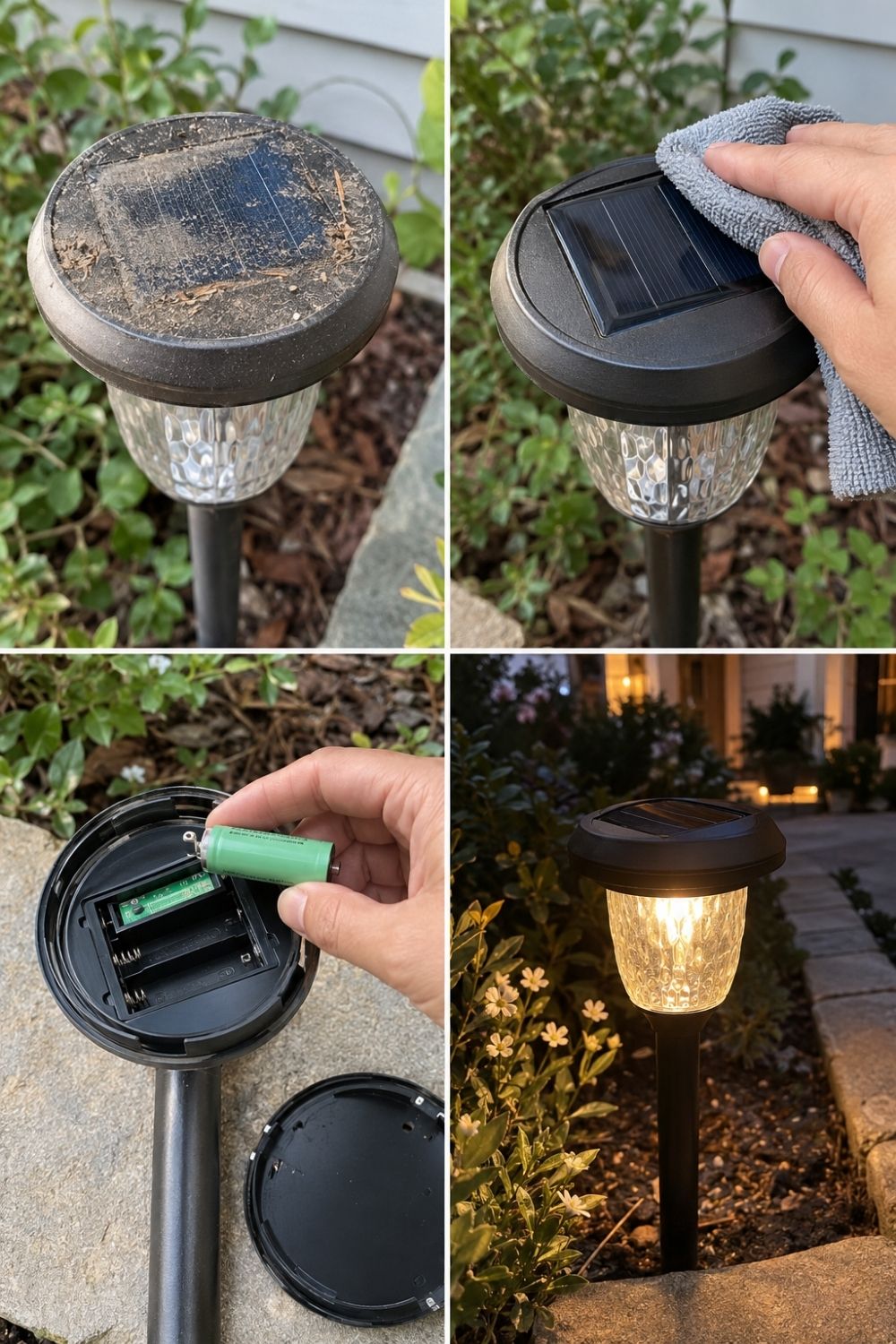
Photo by SassyGarden
The four photos above show the whole routine: a solar path light with a panel covered in dust and debris, the panel being wiped clean with a soft cloth, a worn rechargeable battery being swapped out, and the same light glowing brightly again at night. A few habits keep solar garden lighting working:
- Wipe the panels every few weeks with a damp cloth. Pollen, dust and bird droppings cut charging a lot.
- Check the sun. Most solar lights need 6–8 hours of direct sun to last through the evening. Plants grow over the summer, so a spot that was sunny in May may be shaded by July.
- Replace the batteries every year or two. Most use rechargeable AA or AAA NiMH batteries; use the same type and capacity, never regular alkaline ones.
- Expect shorter nights in winter. With fewer hours of sun, lights run for less time. Store cheaper ones indoors over winter to extend their life.
- Check the switch. Many lights have a tiny on/off switch under the cap that’s easy to knock.
The first summer I had solar path lights, half of them seemed to die by the end of July. A good wipe and a pack of fresh batteries brought every one back. For more fixes, Festive Lights has a helpful checklist of what to do when solar lights stop working.
Start with one zone: light the path or the patio first, live with it for a few evenings, then add a spotlight or a string of lights where it feels too dark. A few warm, well-placed solar lights are all it takes to make those long summer evenings last a little longer.