
Shade has a bad reputation in gardening. People talk about it as a problem to fix, a spot where “nothing grows” and the lawn gives up. In reality, a long list of plants grow well in shade, and many of them do better there than in full sun: they keep their leaf color, need less water and don’t scorch in August. The trick is knowing what kind of shade you have, because a bright corner under a high tree canopy and a dry patch under a maple are very different places to grow.
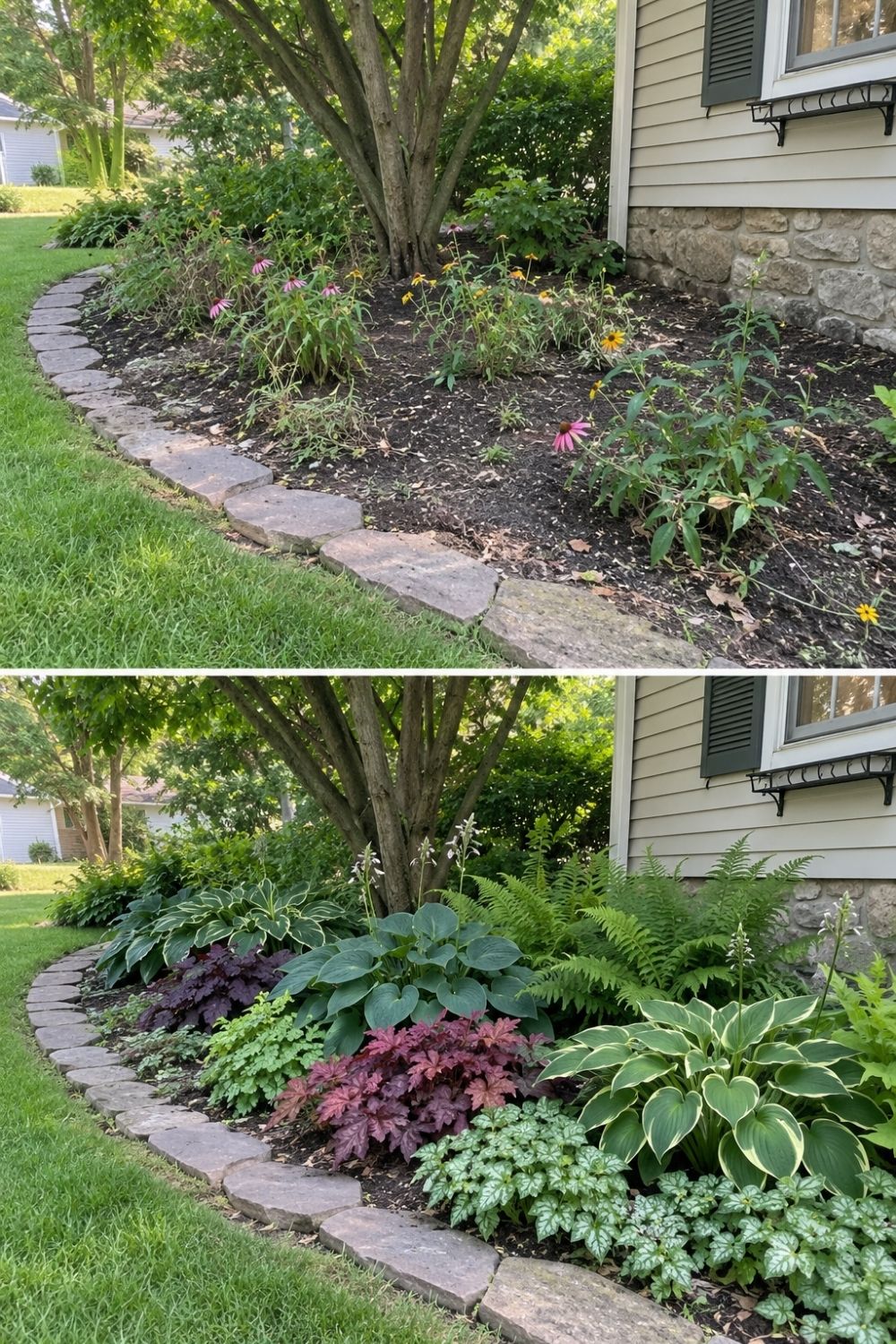
Photo by SassyGarden
The before and after above shows a shady bed at the corner of a house, under a small tree. At first it holds a few scattered perennials and a lot of bare soil. After replanting, the same bed is full: blue and variegated hostas, burgundy heuchera, a clump of ferns and silver-leaved lamium spilling over the stone edge. None of those plants would look as good in full sun. The shade isn’t the problem; the plant choice was.
First, figure out what kind of shade you have
“Shade” on a plant tag can mean anything from a few hours of cool morning sun to deep gloom under evergreens. Before you buy anything, spend one sunny day checking the spot every hour or two and note when it’s in direct sun. Then match it to one of these:
- Light or dappled shade: sun filters through a high canopy all day, like under a honey locust or birch. Most shade plants love it, and some sun perennials cope.
- Partial shade: 3–6 hours of direct sun, ideally in the morning. Afternoon sun is much hotter, so a west-facing spot with 4 hours of afternoon sun is tougher than an east-facing one with the same number of hours.
- Full shade: less than 3 hours of direct sun, often on the north side of a building or under dense trees.
- Dry shade: shade plus competition from tree roots, which take most of the water and nutrients. This is the hardest type, and it needs its own plant list.
The direction your garden faces changes all of this, too; I covered that in detail in my post on north-, south-, east- and west-facing gardens.
Light and partial shade: the easy kind
If your spot gets morning sun and afternoon shade, congratulations: that’s one of the best growing conditions in the garden. A huge range of shade plants will thrive, and many flower well.
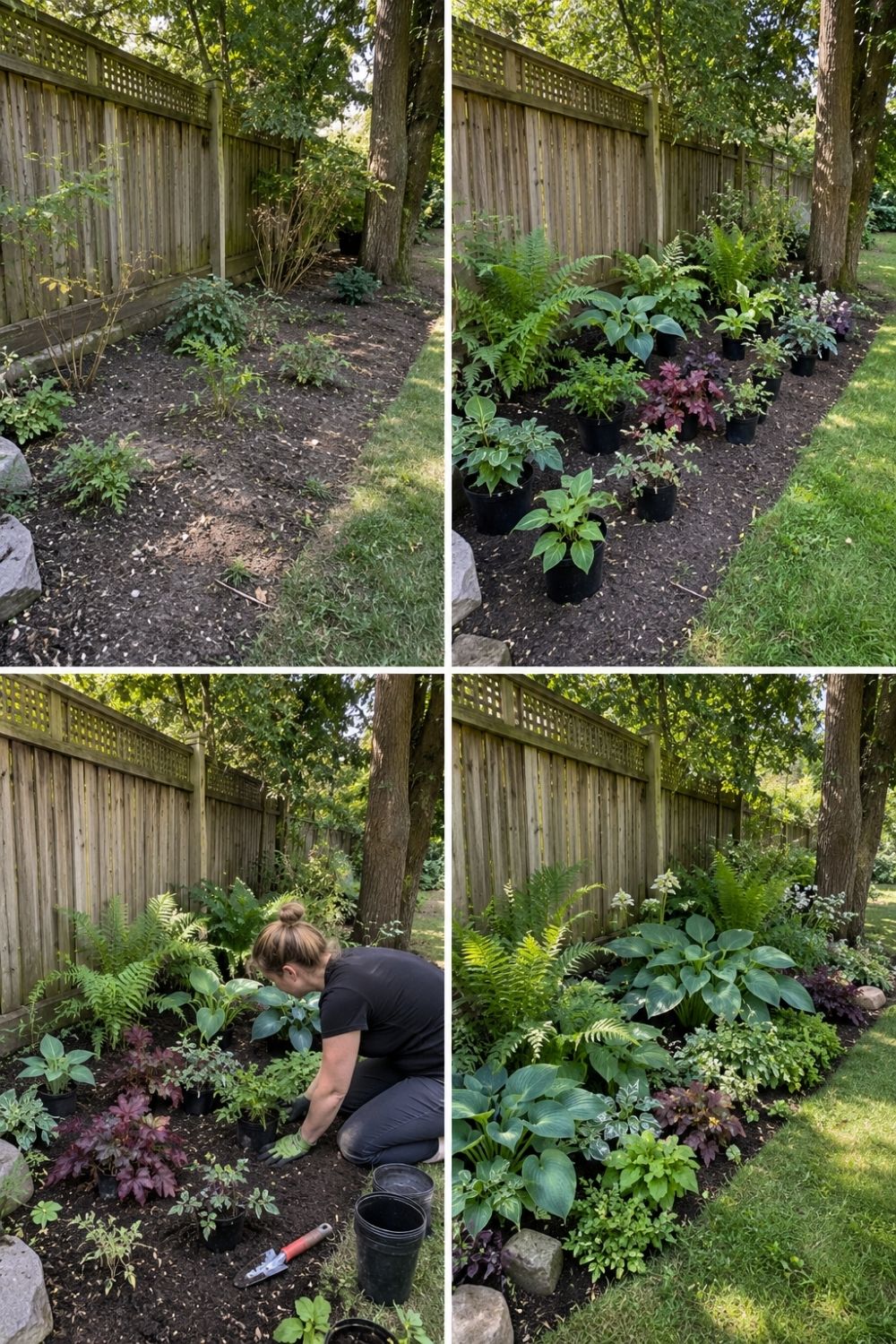
Photo by SassyGarden
The four stages above show a shady strip along a wooden fence, first almost bare with a few weeds, then with pots of ferns, hostas and heuchera set out, then being planted, and finally the finished shade border with layers of green, blue and burgundy leaves. Good choices for this kind of spot include:
- Astilbe for feathery plumes in pink, red or white in early summer; it wants moist soil.
- Hydrangeas, especially bigleaf and oakleaf types, which prefer afternoon shade in hot climates. My post on when to plant hydrangeas covers timing.
- Heuchera (coral bells) for leaves in lime, amber, silver and near-black.
- Lady’s mantle, whose soft, scalloped leaves hold raindrops like beads.
- Toad lily for unusual spotted flowers in late summer and fall.
Plant in drifts of three or five, and repeat the same few plants along the border rather than dotting in one of everything. Shade gardens rely on leaf shapes and textures more than flowers, and repetition is what makes them look designed.
Full shade: foliage does the heavy lifting
In full shade, most flowering plants give up, but foliage plants shine. Leaves in every shade of green, blue, gold, silver and white can make a full-shade bed as colorful as a sunny border.

Photo by Karl Børre Frydenlund on Pexels
This close-up of a variegated hosta, with bright green leaves edged in creamy white, shows why hostas are the classic shade plant. They come in sizes from a few inches to several feet across and in dozens of leaf colors, and white or gold variegation brightens the darkest corner. Other full-shade stars:
- Ferns such as Japanese painted fern (silver and burgundy), Christmas fern (evergreen) and ostrich fern (tall, for moist soil).
- Japanese forest grass (Hakonechloa), which forms soft, arching mounds of gold or green.
- Solomon’s seal, with arching stems and small hanging bells in spring.
- Lamium and sweet woodruff as ground covers, though sweet woodruff spreads freely.
One design trick for full-shade plants: mix at least three leaf shapes in each group, such as broad hosta leaves, fine fern fronds and grassy blades. Contrast in shape does the work that flower color does in a sunny bed.
Dry shade under trees
Dry shade under trees is where most shade gardens struggle. Tree roots take the water, the canopy blocks the rain and the soil is often thin and compacted. But even here, plenty of plants grow well in shade once they’re established.
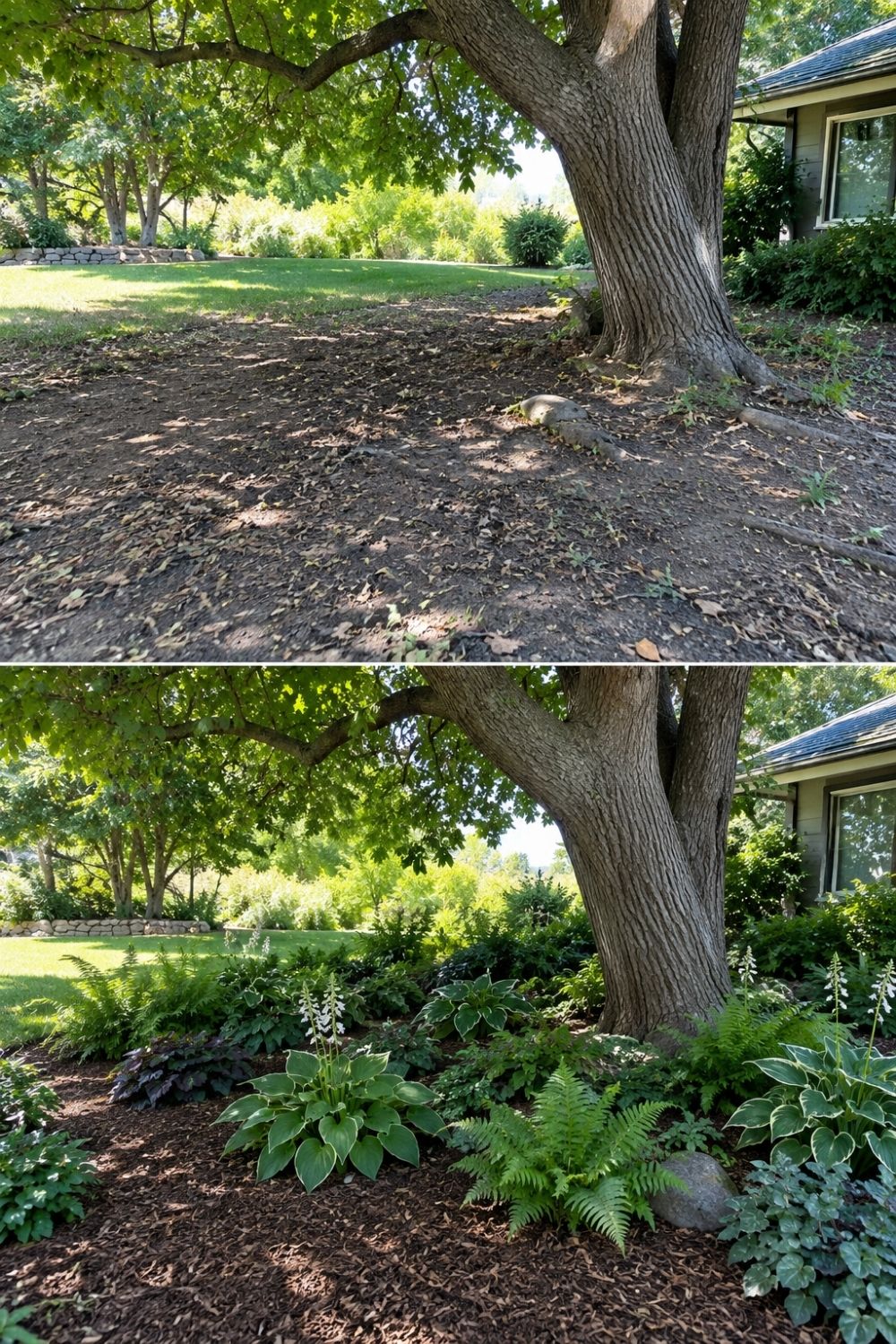
Photo by SassyGarden
The before and after above shows a large tree with bare, dusty soil and patchy grass under its canopy, then the same spot planted with hostas, ferns and low ground covers under a layer of mulch. The trick is planting with the tree, not against it:
- Don’t pile soil over the roots. Adding more than an inch or two can suffocate them. Instead, plant small plants into pockets between roots.
- Choose small plants. Plugs and 4-inch pots are easier to tuck in without cutting roots thicker than a finger.
- Water every week for the first year, even in rainy spells, since the tree gets there first.
- Mulch with 2 inches of shredded leaves or bark, kept away from the trunk.
The toughest dry-shade plants include epimedium (barrenwort), bigroot geranium (Geranium macrorrhizum), Christmas fern, hellebores and liriope. Swansons Nursery’s guide to plants for dry shade has a longer list with photos. Shallow-rooted trees like maples are the hardest to plant under; with those, a ring of mulch and a few containers is sometimes the kinder solution.
Color without flowers
If you want strong color in a shady spot, look to annual foliage plants. They brighten dark corners for a single season and fill gaps while perennials grow.
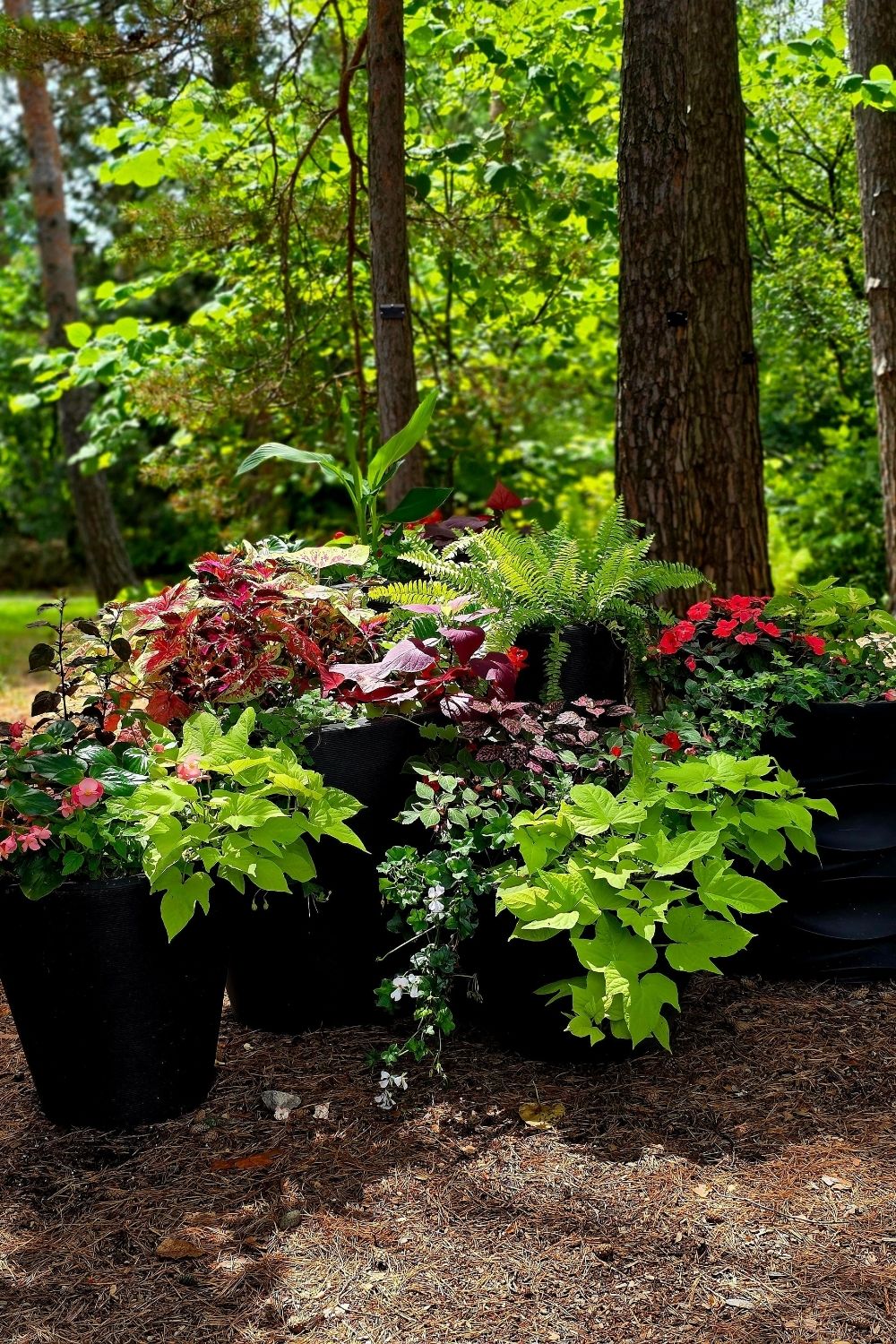
Photo by Zoryana Lavruk on Pexels
This group of tall black pots under tall trees is full of red and burgundy coleus, pink caladiums, red impatiens, a fern and chartreuse sweet potato vine spilling over the edges. The bright lime and hot pink read clearly even in deep shade, where pastel flowers can disappear. Coleus, caladiums, impatiens, begonias and fuchsias are all reliable annual shade plants. Grouping them in pots is easier than planting them in the ground under trees, and you can move them as the light changes. Keep them well watered, since pots under a tree canopy catch very little rain, and feed them lightly every few weeks to keep the leaf color strong.
Hosta alternatives for slugs and deer
Hostas are the go-to shade plant, but slugs and deer love them almost as much as gardeners do. If your hostas end up looking like lace every summer, try these instead:
- Brunnera ‘Jack Frost’, with heart-shaped silver leaves and tiny blue spring flowers.
- Pulmonaria (lungwort), with silver-spotted leaves and pink-to-blue flowers in early spring.
- Bergenia, whose big, glossy leaves turn red in winter.
- Hellebores, evergreen and flowering in late winter, when little else does.
- Epimedium, tough, delicate-looking and rarely touched by deer.
- Japanese forest grass, which gives a similar soft mound shape.
None of these is fully deer-proof, but deer and slugs tend to leave them alone when easier food is around. Keep in mind that hellebores are toxic to pets and people if eaten, so plant them away from where dogs dig.
Native shade plants
Woodland natives are shade specialists, since they evolved under forest canopies. In North America, good choices include wild ginger, a low ground cover with heart-shaped leaves; foamflower, with frothy white spring flowers; woodland phlox in soft blue; native Solomon’s seal; and Christmas fern. Many of them also feed early bees and other pollinators, which makes them great partners for a sunnier native pollinator garden elsewhere in the yard.
Woodland natives like the same conditions a forest floor offers: loose soil, a layer of fallen leaves and little disturbance. Leave the autumn leaves where they fall in these beds; they act as free mulch and feed the soil as they break down.
Tropical-looking shade
Big, bold leaves give a shady spot an instant jungle feel, and many tropical plants actually prefer shade outdoors.
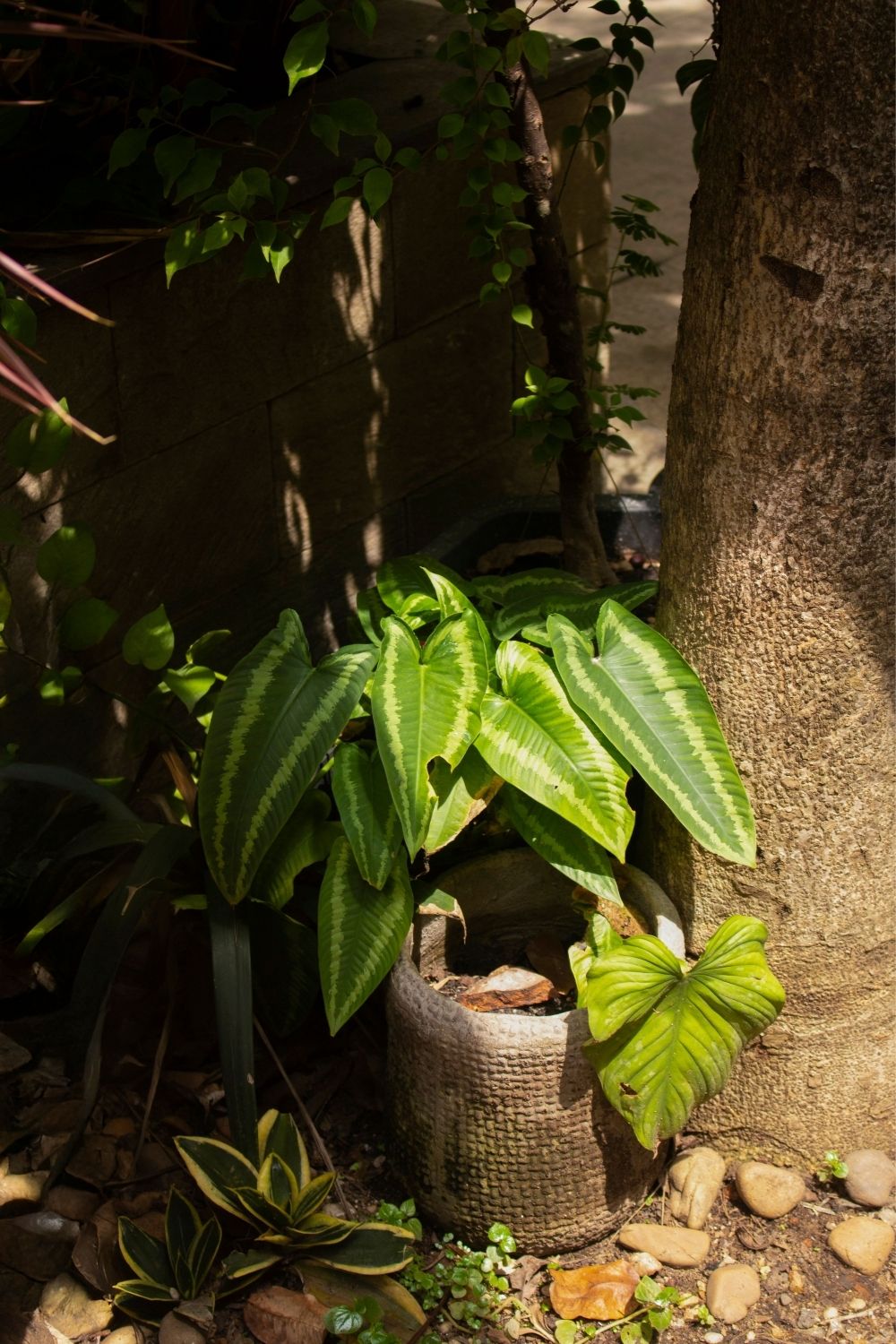
In this shady corner, a large-leaved tropical plant with striped, arrow-shaped leaves grows in a rough stone pot at the foot of a tree trunk, with smaller plants among the pebbles below. Alocasia, caladium, elephant ears and even a potted monstera can spend summer outdoors in shade and move back inside when nights drop below about 50 °F. They’re hardy outdoors only in the warmest zones, roughly 9–11. Alocasia, caladium and monstera are toxic to cats and dogs if chewed, so place them out of reach of curious pets. To create a focal point in a shady corner, a single big-leaved plant in a large pot works almost like a garden sculpture; I covered placement ideas in my post on garden statues and sculptures.
Shade plants in pots
A shady porch, patio or balcony can be one of the most comfortable places to sit in summer, and containers make it easy to add green.
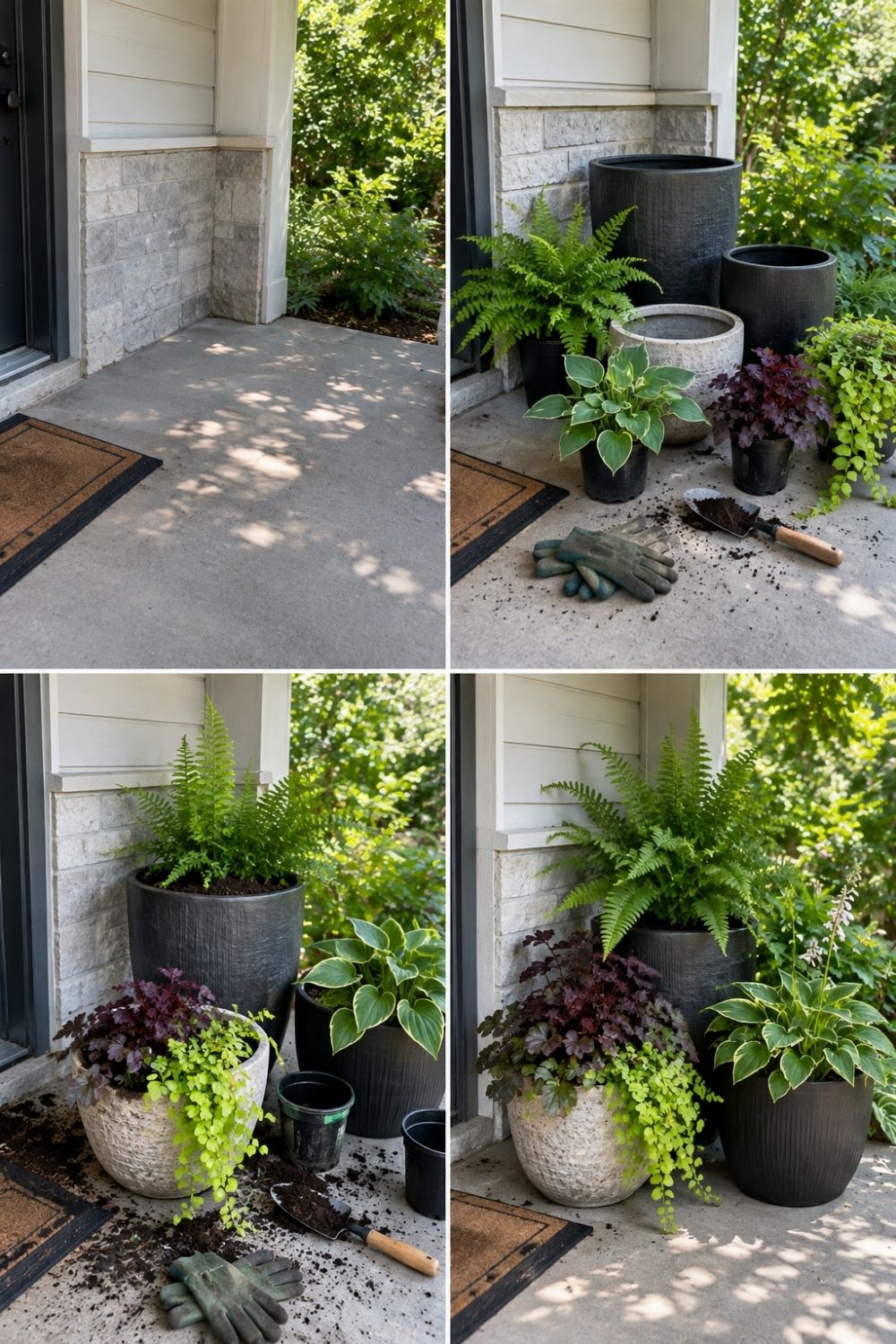
Photo by SassyGarden
The four stages above turn a bare, shady front porch into a welcoming corner: first an empty concrete corner by the door, then dark pots, soil and plants gathered together, then planting, and finally tall pots with a Boston fern, a hosta, burgundy heuchera and golden creeping Jenny trailing over the rim. Shade containers dry out more slowly than sunny ones, but check them regularly anyway, especially under a roof where rain doesn’t reach.

Photo by Pham Hien Triet on Unsplash
This small, shady balcony is packed with pots and planters of leafy greens, grassy plants and trailing vines against a gray wall, proof that a shady balcony can still feel lush. The thriller-filler-spiller idea works just as well in shade: a fern or caladium for height, heuchera or begonias to fill, and creeping Jenny or ivy to trail. For more combinations, see my guide to container gardens.
Make the most of the light you have
A few simple changes can make a shady garden feel brighter and grow better, without cutting down a single tree.
- Use pale leaves and white flowers. Variegated hostas, silver Brunnera, white astilbe and white impatiens reflect what little light there is and seem to glow at dusk, just when you’re most likely to sit outside.
- Lighten the hard surfaces. A pale gravel path, light stepping stones or a white-painted fence bounce light back into the planting.
- Raise the canopy. Having an arborist remove a few lower branches from a large tree lets in far more dappled light than you’d expect, and it’s much kinder than removing the tree.
- Stop fighting for lawn. Grass needs more sun than most shady spots get. In deep shade, replace thin, mossy lawn with a ground cover like sweet woodruff, lamium, epimedium or wild ginger, or a simple mulched bed.
- Feed the soil with leaves and compost. Most shade plants come from woodland floors and grow best in loose, humus-rich soil. A thin layer of compost each spring does more than any fertilizer.
Quick reference: shade plants by type of shade
| Type of shade | Good shade plants | Approx. USDA zones |
|---|---|---|
| Light or dappled | Astilbe, hydrangea, heuchera, lady’s mantle, toad lily | 3–9 |
| Partial (morning sun) | Hosta, Japanese forest grass, bleeding heart, Brunnera, foamflower | 3–9 |
| Full shade | Hosta, ferns, Solomon’s seal, wild ginger, lamium | 3–9 |
| Dry shade under trees | Epimedium, bigroot geranium, hellebore, Christmas fern, liriope | 3–10 |
| Shade containers (annuals) | Coleus, caladium, impatiens, begonia, fuchsia | Annual (caladium perennial in 9–11) |
The takeaway: start by watching how much sun the spot really gets, pick plants for that kind of shade, and lean on leaves before flowers. A shady garden built on hostas, ferns, heuchera and a few bright annuals can look cooler, calmer and more lush in July than any sunny border.